Library/Show Me Your Stack 3
From Clay Tables to Intent HQ: Building the BDR Action Layer
Why Garrett Wolfe stopped trying to fix BDR prospecting inside the CRM and built a Claude Code action layer on top of it, the system behind $15M in pipeline in 12 months
This episode: Garrett Wolfe walks through an account scoring and signal pipeline built in Clay, then shows the custom Intent HQ web app built in Claude Code that sits on top of it. The system has taken teams from 0 to $15M in pipeline inside 12 months. The breakdown below maps the build back to the Revenue Architecture.
The Action Gap That BDRs Live Inside
Most BDR workflows fail at the same place. The account list exists. The signals exist. The intent data exists. But the rep still spends two hours every morning toggling between the CRM, LinkedIn Sales Navigator, and Apollo, trying to answer three questions: which accounts do I own, who at those accounts should I call, and why now. The prospecting tools surface signals at the company level. The contact tools surface people. The CRM tracks ownership. Nothing connects them.
This is not a data gap. It is an action layer gap. The data is already in the stack. The rep is the integration layer, and the rep burns their highest-leverage hours doing the integration manually.
Garrett Wolfe has spent the last year building the action layer that closes that gap. He was employee number nine at Unify, where he built their automated outbound program from zero to over $15 million in pipeline inside 12 months, and helped scale ARR from under $1M to over $5M in roughly 13 months using Unify, Clay, and n8n. He founded 1GTM, a GTM engineering consultancy, and co-authored the first State of GTM Engineering report surveying 225+ practitioners globally. Before that, growth equity at TZP Group, investment banking at Morgan Stanley, CS degree from Duke.
In this episode, Garrett walks through the full build. First, how Clay tables and signal workflows actually get constructed, not the marketing version. Then the production layer: a custom web app built with Claude Code that gives BDRs a single pane of glass replacing the CRM-plus-Sales Nav-plus-Apollo shuffle. The gap between a Clay table and the Intent HQ is the entire argument for why GTM engineering is architecture, not tooling.
The Scoring Foundation: Why Most Teams Start in the Wrong Place
Garrett’s first structural point is that most BDR teams start their day picking accounts by gut feel. Ten favorites for the week. Whoever the rep met at a conference last month. Whoever’s logo is familiar. The scoring layer does not exist, so prioritization defaults to whatever is top of mind.
Garrett inverts that. He pulls tens of thousands of companies into Clay and scores every one of them across firmographic and technographic criteria before a rep ever looks at the list. Headcount. Revenue. Leadership composition. Recent news. Engineering count. Infrastructure hires. Each criterion normalized to a zero-to-one score. The composite determines tier.
The data waterfall starts with Lead Magic (Garrett’s first-call enrichment source), then layers in revenue, LinkedIn, and employee data. The waterfall pattern matters: if one vendor misses, the next one fills the gap. A single-source enrichment pipeline has a coverage ceiling. A waterfall does not.
Accounts scoring above roughly 40% qualify for signal monitoring. Everything below that gets deprioritized before signal aggregation even runs. This is the step most teams skip. They jump straight to “find hiring signals at companies” without establishing which companies qualify. The result is a BDR queue full of signals from accounts that were never a fit to begin with.
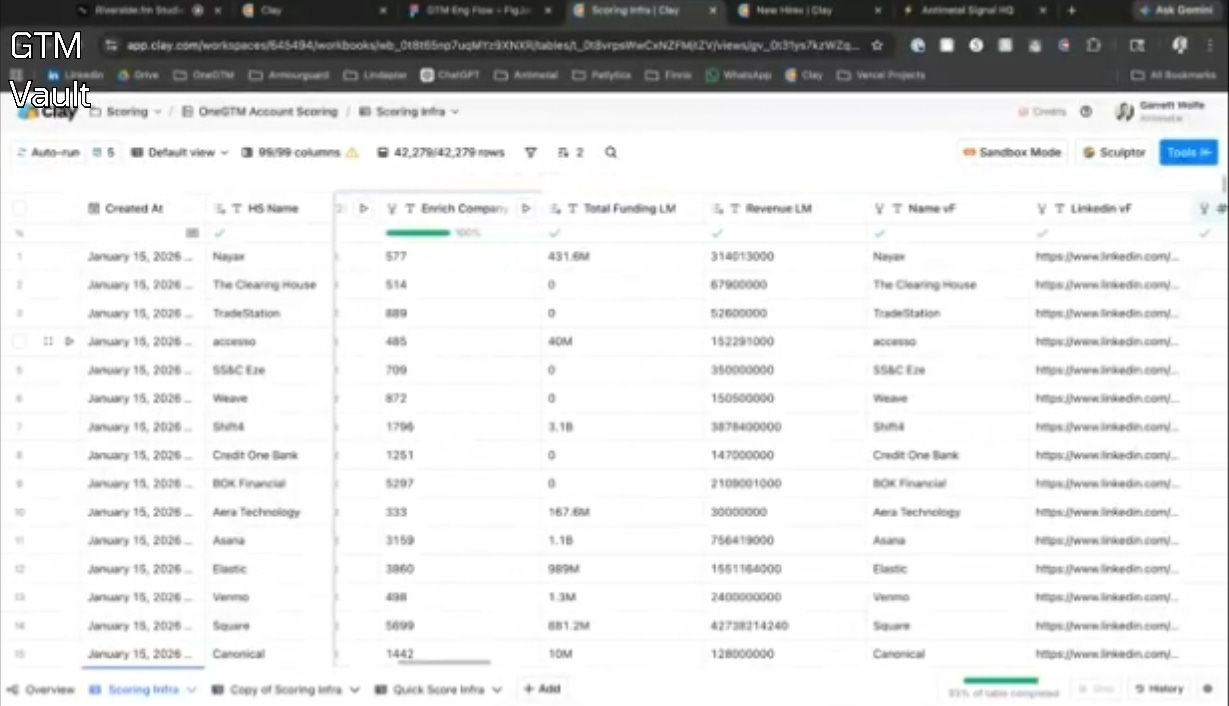
SCREENSHOT: Clay table showing tens of thousands of accounts with merged firmographic and technographic fields, industry classification, industry score, and waterfall-sourced LinkedIn/revenue/employee data.
Full transcript
Machine-generated transcript from the episode video. Speaker labels are not included and some names and product terms may be transcribed phonetically.
[0:00] Welcome back to Show Me Your Stack, episode 3. Today I'm sitting down with Garrett Wolf. Garrett was employee number nine at UniFi, where he built their automated outbound program from zero to over 15 million in pipeline within 12 months. He helped scale ARR from under a million to north of 5 million in about 13 months using unified clay and he's since founded one GTM a GTM engineering consultancy and co-authored the first state of GTM engineering report serving 225 plus practitioners globally before all of that growth equity at TZP group investment banking at Morgan Stanley CS degree from Duke he knows the tools and he knows the numbers behind them. In this episode, we're going to do two things. First, we're walking through how clay tables and signal workflows get built. Not the marketing version, the real version. How you structure the tables, where the signals come from, how the data flows, and where it tends to
[1:02] break. Then, we're going to take all of that and build toward a final product, an intent HQ, a centralized system where your BDRs log in and immediately know which accounts are showing intent and who to call first. It's not a dashboard they ignore, not a spreadsheet. They tab through a single pane that takes signal data and turns it into prioritize action. Garrett, welcome to Show Me Your Stack. Love that name. Thanks for having me. Let's get right to it. if you want to share your screen and sweet. I guess like a little bit of a precursor um and not to like overwhelm but this is kind of an overview of like some of the systems that I tend to build for folks and it's really like an end toend let's say flow diagram of like how we're going to a like ingest all of the accounts in someone's TAM score it and prioritize those accounts based on criterion they care about headcount revenue if they have certain types of leadership if they've at recent, you know, news
[2:04] announcements of certain types, etc. Ultimately, prioritize those accounts and then go through the actual outbound process of finding people at those accounts, finding reasons to reach out and then sending emails on LinkedIn. This signal is something that I build for all the clients that I work with at one go to market across industries, both B2B SAS, but also like services businesses in the legal space, PE space, etc. Um, and one of the things that a bunch of my clients have touched on with me is that their existing sales and BDR teams really need bespoke tooling that fits directly into their workflow. And so when I think about where the highest leverage area is to drive returns, it's helping those people be far more efficient with their jobs since that is one of the last frontiers, let's say, that BDRs and sales teams are working on. And so what is the best way to enable any team? It's to build a really good foundation that is set on data first and foremost and then you can build pretty incredible things on top of
[3:07] that. So to actually walk through this, I'll kind of show you like the way that we are actually scoring some of our accounts and then we actually can jump into some of like the signal aggregation to discern uh how we actually pipe this into more of a bespoke tool that we've built using cloud code and just a decent understanding of the various APIs that we have. So if this clay table ever loads, let's see, we essentially are pulling in for tens of thousands of companies a actual list of all of these various criterion that we care about. We'll just demo this as if it is working. And so we will actually merge a bunch of fields that we care about from aographic and technographic perspective.
[3:53] So you can see here we're jumping through all of these accounts. We'll then classify them based on industry. We'll score that industry. We'll pull in data from a data waterfall starting with Lead Magic. Shout out to them. One of my favorites. We will pull in revenue data, their LinkedIn, their number of employees, and then we basically walk through and score each of these criterion that we pull in so that we can have a really good idea of if every criteria that we care about is scored on some continuum of 0 to one. where do they fall within that 0ero to one and that will allow us to say on a account basis how can we actually prioritize each account and then we can sift scores into various tiers. So here we're sifting through a bunch of different signals hiring revenue engineering count infraine and then ultimately we will actually score these people from one all the way down to zero. And so we're jumping through all of these accounts many of which you and I have definitely know to some extent. So that is the foundational start of like let's figure
[4:57] out what accounts are important to us and why rather than having BDRs say hey I'm going to go you know pick my 10 favorite accounts for this week and then you can move into some of the more interesting things which is signal aggregation prospecting enrichment and then ultimately how do I give my sales team that data that isn't just a CSV or a dashboard that they're not going to use. Sweet. So just to like jump into the next phase then I mean this is like super vanilla. I'm just going to show one of them but we'll basically say on some set of our accounts let's say our top 60 to 70% of accounts in our TAM you know companies that have scored better than 40% let's say on like an overall score basis we'll say hey how should we let's go look for various signals that we care about and reasons to reach out.
[5:47] And so in this case, we're using Clay's native new hire signal that is only filtered to this set of accounts that we have specified based on the score such that we can say hey pull the pull this data in. Let's pull the associated company. We can see the score associated with each person. Each one of these rows is a different person. And then we can actually say hey like go and qualify this person using like some you know uh chat GPT or or open AI like API model and we're qualifying disqualifying various people and then we ultimately on the list of qualified people we say hey okay now we have all this great data let's map them to a persona and then let's actually say hey go run a data waterfall where we'll look through a number of different vendors with an email find node as well as a validation node such that we can find accurate work emails. We will pop out uh a list of validated and enriched emails. We'll actually go through and normalize people's names to get rid of various
[6:49] like data points and then we'll create like a personalized first sentence which we do and then we'll go and drop this into two different campaigns based on the persona. Drop it into like a hey reach which is a LinkedIn automation. will notify the team if we hit a certain if the score is above a certain threshold. And then in some cases I pipe this data into Google Sheets. And so what this does is the second part of this diagram. We're saying we meet the scoring criteria and we have discovered intent. Now let's do warm outbound. And associated with that warm outbound, we're saying, you know, check if check if the person is at an account that should be disqualified because they're a current customer or they're a prospect. We're then saying go and get, you know, determine if they actually are the right person to reach out to and then go and get their contact information in a reliable way and then they'll be dropped into a combination of outbound workflows and then sync back to our CRM such that the team can recognize it. But this this activity which like people have coined go to market engineering is
[7:51] fundamentally like at best a practice that can get you anywhere from like 1% to 12% reply rates and that includes like sometimes like out of office things like that and so you begin to ask the question as this scales uh can I send like better automated emails or for existing organizations that have sales teams how can I empower them to use the data that we're flowing through in this diagram to build really strong sales motions and do cool things with that on top. And so something that I will actually build for folks is like a custom web app that sits on top of this that you had so kindly like described at the beginning of this call that actually gives BDRs that actionoriented, you know, centralized place. So, at least what I've seen from working with a bunch of teams is they're jumping back and forth between their CRM, Salesnav, Apollo, and they're basically trying to figure out what are the accounts I care about. Is it is it in my name and do I own this account or who owns this
[8:53] account? Can I find people in sales now that are interesting? And then I'm going to use like Apollo or the Apollo Chrome extension to like find their in contact information and then send that to a dialer or drop them into an automated sequence. I think that there are a lot of tools that are trying to like pull that together into one place, but for me, I'm really just trying to like use as much of our existing infrastructure as we can and abstract away a bunch of the complexities of using LinkedIn and Apollo. And so what that looks like is I've created, this is like just a complete sandbox, but I've basically created a web app that sits on top of our one of our clients like example CRM. And so in this case, it's for a client of mine, Antimetal, and we're actually pulling in all of their CRM data just like you might see in the CRM or even like very similar to some list building platform. And you can immediately filter down to any of the companies or people that you might be interested in with like the associated signals. And so here you can see, you know, we can jump in
[9:56] and we can see information on Merkore. We can see information about them that we're pulling in from our CRM. This is not net new enrichment. You can see existing signals that we've seen and the dates associated with them. So, we've seen that they fundraised. They have someone from their company recently followed our page. You can click into this information and see info about them just like you would want to in a very quick fast way. And then you can I'll I'll leave some stuff for the end, but you we basically give you the info the ability to prospect into these accounts rather than needing to use a LinkedIn sales nav or an Apollo. And so I'll show you what that looks like in a second, but you can now filter down to any signal that you care about, the like type of company, the country that they exist in, all of these things that would allow any BDR or team of BDRs to quickly generate a list of like very high fit prospects and the talk track that they can probably use associated with the intent signal. So that's like number one. And the same exists for individual people. So if we jump over to this
[11:00] people tab, you can actually see that we've pulled in a bunch of intent signals for individualized people that we are saying, hey, these are instead of like a company that is shown intent, this is the actual person itself. So if we scroll down and there's a lot of people hitting our website today, so apologies for that. But we can see individual people who have visited our website. This is the CTO at Docupace. We have a verified email and we can give you the ability to enrich for their phone number. Hopefully the demo gods like me here and we return good data. Awesome. And so you can actually go through cut this list in the same way of people that have, you know, recently shown some form of intent. This is a new hire as well, so maybe we try to get their phone number. Great.
[11:45] And Garrett, off the top of your head, do you have any idea of how many, say, hours burned per week on a process like this? Yeah, this is like the daily struggle of BDRs, right? They will they will sit in all of these tools each and every day before they go and cold call folks or go and cold email folks. And so the goal that I have is like can I just give them the ability to curate their own lead list or even give someone who's maybe like a revops or bisops pro to like cut the cut up the list for them and just deliver it to them so they can instead of using their time prospecting they can just like find exactly what they want and get the data associated with it without juggling all these tools. I'd estimate that it probably saves at least like two hours a day for many BDRs that are in heavy prospecting and sourcing roles. Yeah. So, it's it can be quite compelling in terms of time savings and also just sheer convenience.
[12:41] Um there's several manual steps there, right? And not to mention juggling multiple tools at the same time and all of that is now centralized in your platform. Exactly. So I mean like the power of cloud code is uh is substantial and I think it's really impressive what teams can cook up. And so where this ultimately leads is you can see people that you've actually prospected from the prior pages in this experience here. You can actually select these people enrich for various details if you don't have them already and then ultimately export them or sync them to something of your choice. So this is stuff that is already being birectionally synced to and from your CRM. But if you for example like a lot of my clients use Nooks or Trellum, you can up you can download a CSV of the data you care about and then ultimately upload it to that platform and it will have all of the data points you care about already filled out. And the final piece which is always surprising to me is I've been so surprised by how many go
[13:45] to market platforms out there exist where they will tell you that an intent signal exists for a company and then they expect you to either run some workflow that will find people and email them or the onus is on you to actually go find people at that company. And so something that I spent a little bit of time to build is I've actually like kind of collapsed that into just like one click. And so if we actually click into profound, which is like a recently very hot company, we can see some folks that are in our CRM associated with that and some signals associated with it. We can actually hit prospect for this company. And instead of needing to go do this via LinkedIn sales nav or Apollo in two different tools, we'll hit prospect. The demo gods have it out for me today. But if we go check another one and we hit prospect like Airbnb. Okay, maybe we have a bug on our hands. Let's see. Yes, we do.
[14:36] But typically, we will give you the ability to actually find folks at this account and then enrich them immediately and then you can add them directly to this prospecting sheet. And so you'll have a combination of individual folks that have actually shown that we have some sort of intent signal for and the contact data associated with them. and then also a list of people that you have found in our platform via a bunch of APIs in the back end that allow you to add those people to this list as well that have company level signals. And so I think for a lot of teams that is a vast majority of the work that their BDRs are doing which is why it's so exciting to see something like this actually coming to fruition.
[15:17] And how is your platform surfacing those undiscovered leads? Could you elaborate on that? Yeah. You said that the platform will identify prospects that aren't on on their list. Correct. Right. Correct. So what is that based on and how are you identifying that? So everything that you see on the surface level here is in our CRM. All of the companies, all of the people in the people tab, there are there are a lot of people that we often don't have intent signals for that we might want to, you know, find. And so a good example of that is like for for let's see what's like a more fun one like at the company level if we look at something like there's a job posting and we want to go look at a company like Meta we actually know that there's a software engineer engineering manager role that's open and we can click into this link and ultimately see the role and who's associated with it. We also have these other signals over here that are interesting. And if we actually click into, if we click into this, you might
[16:21] say, okay, we actually know that they're hiring someone for this role, but we actually don't have any other like information. We don't know who to reach out to, etc. And so using a direct like prospecting link would give you in classic like demo gods would give you the ability to say, "Hey, I'm actually finding net new people that aren't in my CRM, and now I can go add those people to a calling list." And that's pretty powerful when BDRs are spending time saying, "Oh, I see that there's a job posting. I need to now go use SalesNav and Apollo and three other tools to find the right person versus saying, "Hey, I can just do it all in the same place, and all that stuff's being synced back to my CRM box." So, are you saying that because your mega CRM has the data, you can you can identify even if the prospect isn't in the customer's database, you can still surface that signal. Am I getting that right?
[17:15] So, like two things. One, I don't want to like improperly advertise. This is a simple web app like based on some ver like fairly simple technology that like sits on top of the CRM. So we're it's not replacing the CRM. The CRM is still the centralized source of truth. This is just simply a you know action layer let's say for business development or sales development reps. And secondly it's like we saw for Meta there that they have a intent signal at the company level that is not person specific. If we want to go try to book Meta as a customer we need to we need to call or email a person. And so the next question becomes who do we call? And so that is what this prospecting feature has like we're trying to solve is we will in a typical world show you the selected set of people that exist that company that actually match your pre-baked personas.
[18:09] So we won't show you every person that works at Meta. Obviously we'll show you just people that in you know a theoretical case for antimetal maybe work in site reliability or infrastructure or platform maintenance stuff like that. And that takes the entire part of finding people and enriching those people out of the equation, which is the bulk of BDR's work today. Yeah. I mean, that's got to save so much time, not to mention reduce a lot of costs. Yeah. So, yeah, that's that's kind of like a highle overview. And the goal is I think I think the future of sales is like super highly bespoke and like these cooker these cookie cutter platforms I don't think are going to like win in the long run because it's all about if go to market is one of those things that like always improve like you know takes revenue up into the right. You have such an incentive to be differentiated from your competitors and not all be using the same platform. So the question becomes like what can you actually do as a team putting your heads together to generate that alpha and I don't think that is necessarily always going to mean
[19:12] like building the same vanilla things or using the same vanilla tools and and so that's kind of what has inspired more of a bespoke approach to uh like sales enablement which I've been trying to really focus on. And do you have any numbers on this build? Like the results before and after numbers, time saved, conversion lift, pipeline generated or cost reduced? Yeah, I mean the the automated outbound workflows generate, you know, dozens of of meetings across all of my clients like per per week and per month. So, it's certainly like a worthwhile effort because it's it's a numbers game like email. you send a 100 emails, 20 of them are going to deliver, 10 of them are going to be opened, eight of them are going to click, and five of them are going to reply. Um, so there's certainly like pipeline generated on that side of things, which is what pays back, you know, very immediately for for my work, which is great. And then on this particular tool on the like intent HQ I call it uh it's very very immediate like time savings on the rep side as I said like could be as little as like half an
[20:14] hour to an hour saved per day I would you know think across all my clients um having sat there with them and then in the abs in the very first day that we used this tool at one of my clients within it was like five minutes sitting on a parallel dialer with my sales team, they booked a meeting with like a Fortune 500 company. So, like it was a it's very clear immediate ROI, especially because you like get the person on the phone right away and can have them say yes or no to a meeting. So, that's, you know, super exciting stuff and we continue to see strong like positive excitement associated with getting to use something like this versus like the old way of doing things. As someone who's at the forefront of adoption of AI and outbound and using these cutting edge technologies on a day-to-day basis, what what rate of adoption do you think this is going to happen across the economy? Do you have any idea? Because it's obvious that the traditional anatomy of the sales organization is changing as a or the
[21:17] revenue organization as a result of these technological advancements. The improvements from bleeding edge tech occur in the areas that use bleeding edge edge tech the most frequently first. And so when you think about how it makes its way through the economy like I think most AI and B2B software companies were using these tool 2 years ago and now you're seeing some non-traditional industries. I'm getting uh inbound requests from law firms from construction firms. Someone yesterday was from like a corrugated like manufacturing and like cardboard plant. So I think it's bleeding its way into non-traditional industries and importantly those ones that want to stay a breast of like the latest alpha let's say that exists and I al so that so I think like it's making its way through.
[22:07] I still think the majority of people obviously in the United States and on the planet are not using these tools and they will certainly get there as they become easier to use and exposure and information spreads. And then like the question on on the second half of things and and the second half of what I showed is that for the most part uh I think like cloud code is unlocking and and like these AI tools are unlocking newfound creativity um and empowering employees in ways that they may not have been before. Um I have like a comside degree from Duke and I know how to like code in Python after like being out of college for the last six plus years. But generally like having the ability to have something scraped together by cloud code has like revolutionized how I think about what I can accomplish for my clients. And I think it's it's more instead of uh like problems being more executionoriented now they're more creativity oriented and what are the things that we can do to generate a solution and it's really just thinking
[23:09] of what could a solution be here and then I can figure out how to harness the power of these AI tools to get me there. So, I think it's it's a really exciting time to be an operator and the the folks that leverage this stuff sooner are going to have golden age of potential advantage here. Absolutely. Garrett, thanks so much for joining the show. Of course. Of course. Thanks for having me.