Library/Show Me Your Stack 6
From Five Hours in Clay to Forty Minutes in a Terminal: Outbound Run by Claude Code
Why campaign creation speed, not sending capacity, is the new outbound constraint, and how Tim Scheuer ships split tests across 220 inboxes by prompting an agent instead of building tables
The stack
https://www.youtube.com/watch?v=UHfbiJxbhxg
The bottleneck in outbound moved. It is no longer sending capacity, and it is no longer data access. It is the three to five hours a GTM engineer spends in Clay setting up a single campaign: building the table, configuring the waterfall, writing the AI prompt columns, wiring the export, loading the sequencer. At that cost per campaign, you ship one or two tests a week. The winning angle exists somewhere in the space of messages you never had time to test.
In episode six of Show Me Your Stack, Tim Scheuer walks through how he collapsed that setup time to forty minutes. Tim is the co-founder of Oxygen, a CLI and MCP for go-to-market that lets Claude Code orchestrate the entire GTM stack. The campaign he demos was scraped, enriched, personalized, and launched by prompting an agent in natural language. Three to four exchanges back and forth. No table building. The result from the first 180 emails: eight positive sales opportunities in one of the most over-targeted prospect pools in B2B.
Tim ran a GTM engineering service company before building Oxygen, so the comparison is not theoretical. He has done this work the manual way, at billable rates, inside Clay. His current stack is Oxygen, Claude Code, Instantly, and Zapmail. The interesting part is not the tool list. It is what becomes economically possible when campaign creation stops being the expensive step.
The Target Problem: 1,900 Founders Everyone Else Is Also Emailing
Oxygen sells to technical, fast-growing SaaS companies. The densest pool of those is the Y Combinator directory, which makes it a goldmine and a minefield at the same time. Every outbound vendor, agency, and tool company is emailing YC founders. The accounts are high value and the inboxes are saturated. Reaching them is not the hard part. Differentiating in the inbox is.
Tim’s first move was to tell Claude Code to scrape the YC directory. It returned more than 1,900 SaaS founders from recent batches, with names, LinkedIn profiles, and batch data. That is the raw list. On its own it is worth nothing, because everyone targeting YC has the same list. The campaign’s edge had to come from what happened to the list next.
The Build: From Directory Scrape to Live Sequence in Four Prompts
The entire pipeline ran inside a Claude Code conversation, with Oxygen providing the GTM integrations underneath. The sequence had four moves.
First, enrichment. Tim prompted Claude Code to enrich emails using waterfall enrichment, and the agent built the waterfall table itself: multiple data vendors called in sequence, each one attempting the contacts the previous vendor missed. Apollo, LeadMagic, Prospeo, and BetterContact ran in the waterfall. Where one API returned nothing, the next filled the gap. Email verification ran on top. The point of the waterfall is coverage, and coverage is not cosmetic. Every contact the first vendor misses and the second one finds is a prospect your competitors, running a single-vendor enrichment, never email at all.
Second, personalization. Tim created an AI variable that researches each prospect and generates a line referencing their ideal client profile. Not a generic compliment about the company. A specific claim about who they sell to, which the email then asks them to confirm.
Third, execution. Claude Code pushed the enriched, personalized leads into Instantly, the sequencer of choice, and the campaign went live.
Fourth, the copy itself, split tested across two angles from day one. The winning structure: reference the YC batch, then ask a question built from the ICP variable (”is it right that you’re targeting space manufacturers?”), then ask whether they are using Claude Code, which for this audience they almost certainly are. The call to action is not a meeting request. It is a thumbs-up reply, in exchange for one of Oxygen’s Claude Code repos with pre-built GTM integrations and skills. The prospect’s cost of replying is one emoji. The reply rate follows from that math.
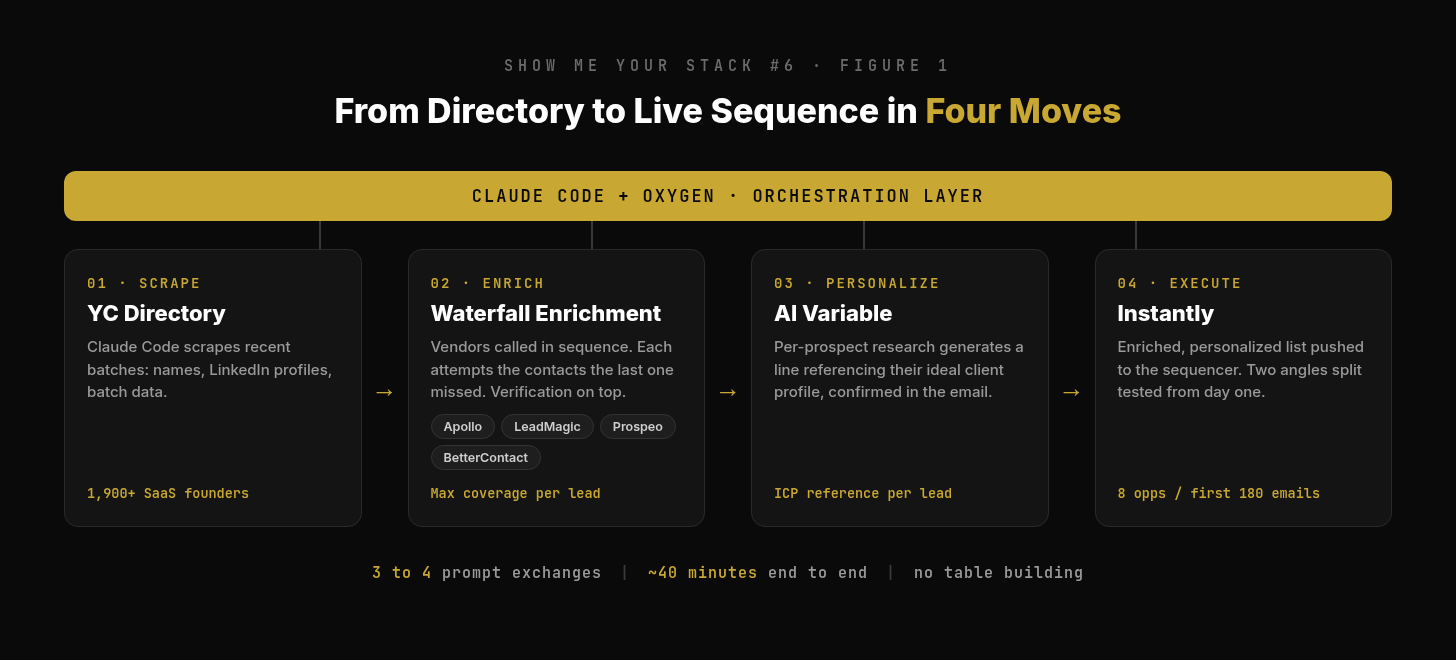
Figure 1. The four-move pipeline from directory to live sequence. Claude Code, with Oxygen’s integrations underneath, scrapes the YC directory, runs waterfall enrichment across four data vendors, generates an ICP-referencing AI variable per prospect, and pushes the finished list into Instantly. The entire build is three to four prompt exchanges, roughly forty minutes.
The Sending Infrastructure: 220 Inboxes Behind a Low-Volume Campaign
The YC campaign itself is deliberately small. Around 180 emails sent at the time of recording, because these are high-value accounts and the play is precision. But the infrastructure behind it is not small, and the gap between the two numbers is the strategy.
Oxygen runs more than 220 inboxes sourced from Zapmail, split 50 percent Google and 50 percent Microsoft. Total sending capacity is around 100,000 cold emails per month. That capacity does not exist to blast 100,000 emails at one list. It exists to run many split tests in parallel. Because Claude Code compresses campaign creation to forty minutes, the constraint on test count is no longer labor. It is sending infrastructure. Tim built the infrastructure to match.
This is the inversion most teams miss. When campaign setup costs five hours, you run few campaigns and each one carries the pressure of being right. When setup costs forty minutes, you run many, each one is a hypothesis, and the sending layer becomes the thing you scale. The split test is not a quality-assurance step at the end of the process. It is the process.
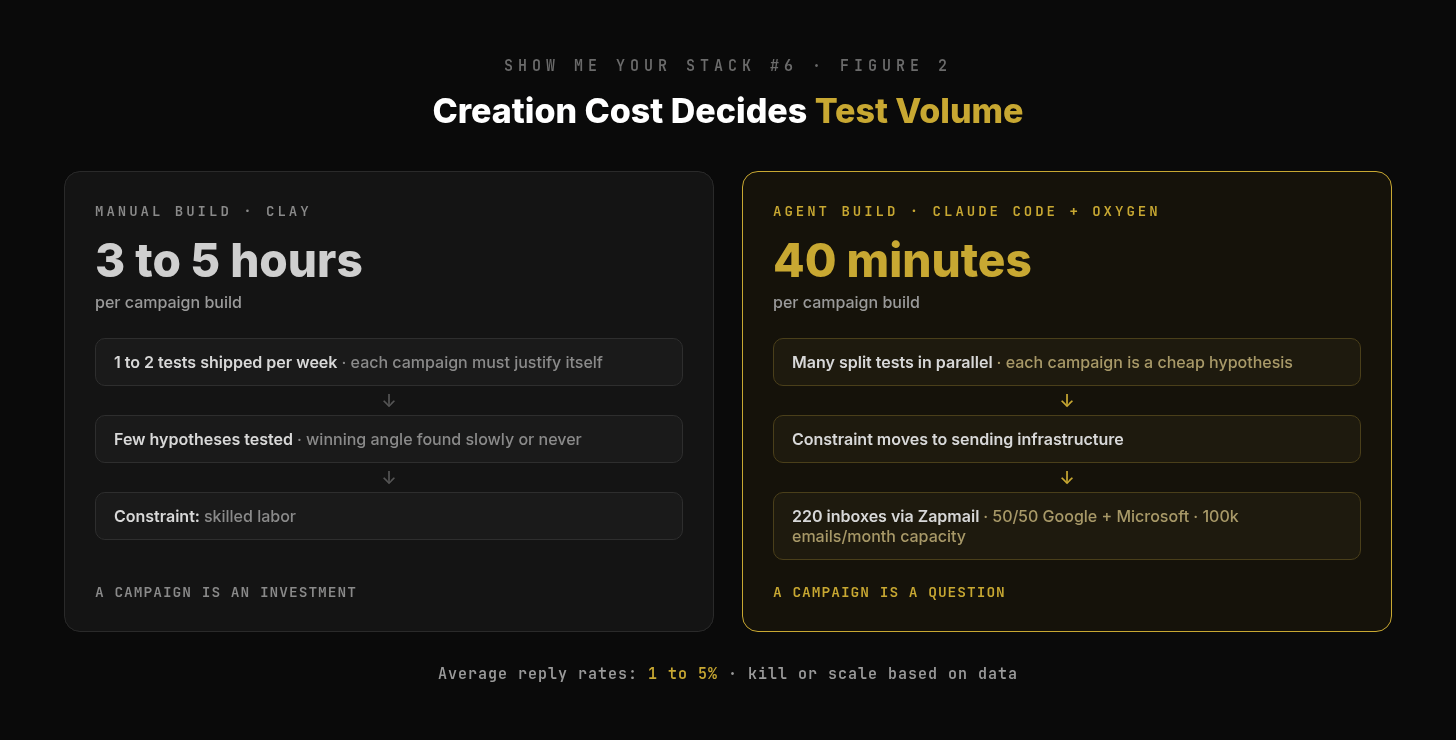
Figure 2. The relationship between creation cost and test volume. At three to five hours per campaign build, a GTM engineer ships one to two tests a week and the winning angle is found slowly or never. At forty minutes per build, the constraint moves to sending infrastructure, which is why a company sending one low-volume campaign to 180 YC founders maintains 220 inboxes and 100,000 emails per month of capacity.
The Compression: What the Numbers Actually Say
The headline compression is time. Three to five hours per campaign in Clay, down to roughly forty minutes of prompting in Claude Code. Call it a 5x to 7x reduction in setup labor per campaign.
The performance numbers need honest framing, and Tim frames them honestly. Average reply rates across Oxygen’s campaigns run between one and five percent, which he describes plainly: it is not magic, but scaled up, it performs. Cold email is saturated and he does not pretend otherwise. The lift comes from two specific mechanisms. The waterfall produces better coverage, so more of the list is reachable. The AI variables produce better personalization, so more of the reachable list replies. Coverage times reply rate times volume of tests is the whole equation.
The number that matters most is the last one in the chain: eight positive sales opportunities from the first 180 emails into the YC pool. Not replies. Positive opportunities, in a market where every founder’s inbox is a wall of automated outreach. That is what the architecture buys.
Where Tim Thinks This Goes in Twelve to Eighteen Months
Tim’s read on the market has three parts, and the first one cuts against his own interest, which is why it is worth hearing.
The barrier to launching outbound campaigns will keep dropping, which means more saturation, which means standing out gets harder, not easier. The teams that win will be the ones that test more rigorously, because when everyone can launch a campaign in forty minutes, the edge is not launching. It is finding the winning formula faster than competitors and then scaling it.
The job changes with it. GTM engineering used to be stitching tools together. That was the skill and the billable work. The new job is forming hypotheses and orchestrating agents, and the new skill is understanding how those agents work well enough to be more efficient than the person running the same agents next door.
The third shift is the one that does not benefit Oxygen at all, which is why Tim flags it. The supply of artificial outbound content is increasing. The supply of human attention is not. So the value of human contact rises: in-person events, networking, conversations like the one on this episode. The companies that win will be extremely efficient in the back end, agents running continuously, and will spend the time those agents free up on the human layer that cannot be automated.
The Pattern
The expensive step in outbound moved from sending to creating, and now it has moved again, from creating to deciding what to test.
When Tim ran his service company, the campaign build was the product. Five hours of skilled labor per campaign meant every campaign had to justify itself before it existed, which meant fewer campaigns, which meant slower learning. Collapsing the build to forty minutes did not just save time. It changed what a campaign is. A campaign is no longer an investment. It is a question, asked cheaply, answered by 220 inboxes, and either killed or scaled based on the data.
If your team still measures outbound capacity in campaigns per week, the constraint is not your sequencer and it is not your reps. It is the hours between the hypothesis and the send button. That is the layer the agent removes.
Timestamps
(0:00) Intro: Tim Scheuer and Oxygen, a CLI and MCP for go-to-market (1:22) Scraping 1,900 YC founders with Claude Code (2:02) Waterfall enrichment across Apollo, LeadMagic, and Prospeo (2:42) AI variables: personalizing on the prospect's ICP (3:24) 180 emails, eight positive opportunities in Instantly (4:06) The copy: split-testing two angles with a repo as the hook (4:46) The full stack: Oxygen, Claude Code, Instantly, 220 inboxes (6:46) Five hours in Clay to forty minutes in a terminal (8:46) Pricing: credits, bring your own key, or pay per contacted lead (10:08) The next 12 to 18 months: split tests, agents, and the human edge
Find Tim on LinkedIn and see Oxygen at oxygen-agent.com. Subscribe to Show Me Your Stack for the next episode.
Show Me Your Stack is a GTM Vault series. Each episode features one operator walking through the actual system behind their outbound, their prioritization, or their pipeline motion. No slides. Just the stack.
Full transcript
Machine-generated transcript from the episode video. Speaker labels are not included and some names and product terms may be transcribed phonetically.
[0:00] Welcome back to another episode of Show Me Your Stack. Today we have Tim Shyer on the episode and he will be talking about how to build an automated outbound motion using cloud code. Tim, take it away. Rick, first of all, thanks a lot for having me on. I'm very pleased to be here. Maybe a bit of more context about me and what we're building for the audience to have a bit more background information. I'm the co-founder of Oxygen and what we're building is a CLI and MCP for go to market which means that cloud code essentially can orchestrate your whole go to market stack which results in you just needing to be able to talk to claw code or codeex and it can create any outbound campaign for you just by talking it to it in natural language. So with this, I'm also glad to to show you a recent outbound campaign that I've done because as you can imagine, we're targeting very technical companies and fast growing SAS companies and a gold mine for that are
[1:03] YC companies of course. So the problem with them, it's hard to reach out and to differentiate yourself. So I'm going to show you briefly what I've built out there. So what you can see on my screen right now is the oxygen database and the way this got populated is I asked claw code that it should scrape the YC directory and for those who don't know YC Y combinate is one of the um startup accelerators one of the most famous ones and there's a lot of high growth startups in there. So we decided we want to get their contact information. So, I told claw code to scrape the YC directory and it has done so and scraped me over 1,900 SAS um SAS founders from the last batches from the last few years. And what you can see here is the batch um which they were in and um all sorts of other information. Now the next challenge that I had is I got the contact information. I got their LinkedIn profile, their name and first name but now I need to enrich their information. So again I was in claw code
[2:07] and I asked claw code it should enrich the email with the waterfall enrichment feature. So within cloud code it has essentially created this table here of this waterfall enrichment as you can see here. So um it is for those who don't know what a waterfall enrichment it is um it is essentially calling multiple data vendors so that you get the highest possible coverage because as you can see here in some cases the blitz API didn't find the result but then prospo found it and based on this we got a high coverage of these leads essentially here lovely and of course what we can do is email verification too for this one next now we have the contact information But it's important that we have some differentiator and can personalize this message. So the next thing that I've done is I've created an AI variable where I'm referencing their ideal client profile. So if we click into this AI column which you can see here, it is essentially generating a personalized variable which references their ideal
[3:10] client profile so that I can reference this in my outbound message which I'm going to show you in a brief second. Lovely. And as the last step, what we have done is we have essentially enrolled these leads into instantly. Um, which I can show you in this section. We have pushed these leads into instantly. And if we head over to Instantly, which is our sequencer of choice. Um, as you can see here, this campaign is still going on at the moment. And we have over 180 emails already sent. Um, which is a low volume, but these are high quality accounts for us. And we've generated already already eight positive sales opportunities out of this which is very good because YC founders is a very competitive market. A lot of people are targeting them and this is the copy that we used to get these results. So if you go on to preview what you can see is we have split tested two different um two different angles. And if I select one of the leads here, as you can see here, we've re we're referencing, hey, I I've seen you've been in the YC batch and is
[4:13] it right that you're targeting space manufacturers? So, we try to to make it a bit a personalized intro to them and yeah, making it natural. And we know that these companies are heavily using claw code and this is one of our value propositions and asking them if they're using claw code. What we offer them to incentivize a positive reply is that they should send a thumbs up to get one of our claw code repos where we have pre-built integrations and skills which which is essentially our platform oxygen. Exactly. So this is essentially how we've generated these replies. Um, and with this I I'm glad to to answer any unclear questions.
[4:55] Is there any other tool you used for this campaign? Yeah. So, if we go over the whole go to market stack, I can summarize this pretty simply by showing all the involved tools. The first one is Oxygen. And that's really one of the main value propositions is because Oxygen has over 90 GTM integrations. You essentially get access to all sorts of data vendors in the waterfall enrichment. So in the waterfall enrichment, we likely use something like Apollo, lead magic, prospo, better contact, ICPS. So a lot of these were in the waterfall enrichment. So that's part of the stack next to oxygen claw code. And the last step of the stack is that we have instantly in our our sending infrastructure essentially. And to be fully transparent and clear, we um if we head over to instantly, what you can see here is we are running several split tests. And this is one of our small split tests. And the reason why we can do this is because we can streamline
[5:56] these campaign creations that much with claw code. That's the reason why we can do a lot of split tests. And um we do this at a relatively high scale with over 220 uh 220 inboxes. And for those who are curious where we're getting them, we're getting these inboxes from zapmail.ai, which is also a part of our stack um which is the sending infrastructure we're using and we're splitting it up to 50% of Google inboxes and 50% of Microsoft inboxes. So that's the stack we use and this essentially gives us a sending capacity of around 100,000 cold emails a month where we can do several different split tests and essentially finding the winning angle.
[6:38] Exactly. And can you talk to me a little bit about the results, Tim? I know it's going to differ per campaign, but in general, how many human hours is this saving or how much more effective is it than say uh just giving chat GPT to all your sales reps and expecting them to uh create the emails and do their their own data enrichment? Yeah. So, as a backstory, previously I've I've done this as a GTM engineering service company and back in the days I was spending around about three to five hours setting up a full new campaign um in clay and now it's really just prompting claw code with around three to four different conver back and forth which costs around 40 minutes to launch an end-to-end campaign. So that's already on the timesaving side where we we we see a benefit. On the other hand, because we have the waterfall enrichment, meaning better coverage and the AI variables meaning better
[7:40] personalization, we're seeing also better results in the reply rate and in the conversion rate. And what I'm talking about, even though email outbound email is very hard nowadays, the market is very saturated. And we still see a lift of reply rates. And for reference, what this specifically means, like our average campaigns is very broad, but is between 1 to 5% reply rates. Exactly. Yeah, that's pretty good. Yeah. And it's not magic, but if you scale that up, that performs well. Let's say it like that. And it's not just about the reply rates, it's about the positive reply rates and if these convert into actual deals. Right. Exactly. So there's multiple dimensions where we see an improvement on the time saving side on the better reply rate better data also gives you more sales opportunities. So yeah I hope that answers the question.
[8:29] Great. Yes it does. And if our audience wants to learn more about this AIdriven GTM engineer model where should they go and do you offer a full service offering or is it self served? It's something we're deeply thinking about at the moment. So at its heart, we're a software platform. You can sign up. We have a free tier which is very generous. So you can try it out for free, see how it works. And then we charge per credits. And if I head over for those who are curious to I feel sleazy to showing this, but it's more for you to understand how everything works because we have two types of offerings. One is the software platform where we just charge per credit. But the big benefit for go to market engineers is that you can bring your own key. So if you have a subscription, you don't get charged per credit. Um it's similar to claim. But on the other hand, we have a um an outcomebased pricing where we only charge for verified contacted lead on email and LinkedIn. And this is our
[9:33] tech enabled service. And we can decrease pricing for our end customers because we streamlined the whole system end to end very far. And we have a tech advantage in comparison to our competition because we've built a whole platform. So that's how we try to differentiate ourselves in the market. Exactly. So we have these two offerings. Um and if you want to learn more about we have a YouTube channel where we've broken down these things and you can always chat with me on LinkedIn. I'm glad to answer any questions. Awesome. And one last question, Tim. What do you think's going to happen with this whole market in the next 12 to 18 months? Yeah, very good question. So, first of all, the barrier to entry to launching account outbound campaigns will decrease. This means more saturation.
[10:20] That makes it even harder to stand out. But our hypothesis is the people who will stand out will test much more, do much more split testing to find the actual winning formula which they then later scale. So the that's the first thing I see that GTM engineers need to be more rigorous with split testing and more datadriven. That's the first thing. The second thing that our hypothesis is that the job is isn't anymore stitching together tools. Back in the GTM engineering days that was mainly the job. Now it's really about coming up with hypothesis hypothesis and orchestrating agents. So the new skill is actually learning how these agents work so that you're more efficient than your competitors. That's the second trend that I see. And the third trend that I think is very valuable even though it doesn't benefit us much is that the human aspect will be obviously more relevant because the supply of artificial content of outbound is increasing and the supply of human content and attention isn't increasing.
[11:21] So the demand and the value will go up. What does this mean? We believe that networking events will be more relevant, in-person events, human contact just like we are talking on on this show right now is definitely a mode. So um that we believe will become more re relevant and the companies who will win will be extremely efficient in the back end meaning having agents running in the background and then combining this with the human touch. That's our hypothesis. I hope this was clear. You heard it here first folks. connect your entire go to market stack and let AI run your outbound using oxygen. Thanks so much for joining the show, Tim.