Library/Show Me Your Stack 5
From Account List to Monitoring Universe: Building the Prioritization Layer
Why the scored list is not the outbound trigger, and how Umar Farooq Adam built the scoring, monitoring, and signal architecture that finds the right 300 accounts every month in a TAM of 150,000
https://www.youtube.com/watch?v=i0pV9eUBfYI
Enterprise account lists are too long to work and too short to ignore. The TAM is mapped. The named accounts are assigned. Reps still spend their week researching the wrong 50 companies because nothing in the system tells them which five to actually open today. This is not a coverage problem. It is a prioritization problem masquerading as one.
In episode five of Show Me Your Stack, Umar Farooq Adam walks through how he solves it at a Global Systems Integrator pushing hard into EMEA on the back of sovereign cloud trends and cloud repatriation. The client has a TAM of more than 150,000 enterprise accounts. They reach out to 300 of them every month. The system Umar built is what decides which 300.
Umar started as an inside sales rep for APAC at Hitachi. He did not wait for someone to build better tooling. He built account research automations to improve his own selling, got pulled into a global pilot, increased lead quality by 60%, and compressed weeks of manual research into two days. He now runs GTM programs globally at Hitachi Vantara and consults IT MSPs and ISVs on automating GTM at gtmstudio.xyz. His stack is Clay, HubSpot, Chili Piper, Outreach, and the Power Platform with the rest of the M365 suite. The unusual part is not the tools. It is how he wires them together inside an enterprise where the data lives in Salesforce, the workflows live in Microsoft, and the motion has to land in both without breaking either.
The Client Problem: Project-Based Selling Into a Commodity Signal Window
Systems integrators do not sell on subscription. Every deal is a project. There is no recurring revenue base to expand against, no predictable renewal motion to anchor outbound timing. The buying window opens when a customer’s infrastructure is aging, their vendors are consolidating, or their cloud workloads are ready to move. The GSI’s job is to be present the moment that window opens, not six months after the deal was already decided.
The sovereign cloud trend and the cloud repatriation window in EMEA created a specific version of this problem. A large cohort of enterprise accounts are evaluating moves from cloud-heavy infrastructure back toward on-premises solutions, driven by data sovereignty regulation, cost repatriation, and one specific structural event: a major mainframe supplier is going end of life. There were three players providing mainframe systems. One is closing that business. The accounts still running those systems need to move, and they need a systems integrator to help them do it.
The window is real. The signal is public. The problem is that 150,000 enterprise accounts fit the rough profile, and the GSI does not have 40 sales reps making 200 dials a day. They have a tight outbound function and a need to be surgically right about which 300 accounts deserve time this month.
Before this system, they were spending £300,000 a year with a specialized research firm in London to answer that question manually.
The Scoring Architecture: Four Layers Into One Number
The prioritization model Umar built assigns each account a score from zero to 100. Four input layers feed that score. Each layer is independent, but the account only surfaces to the top when all four converge.
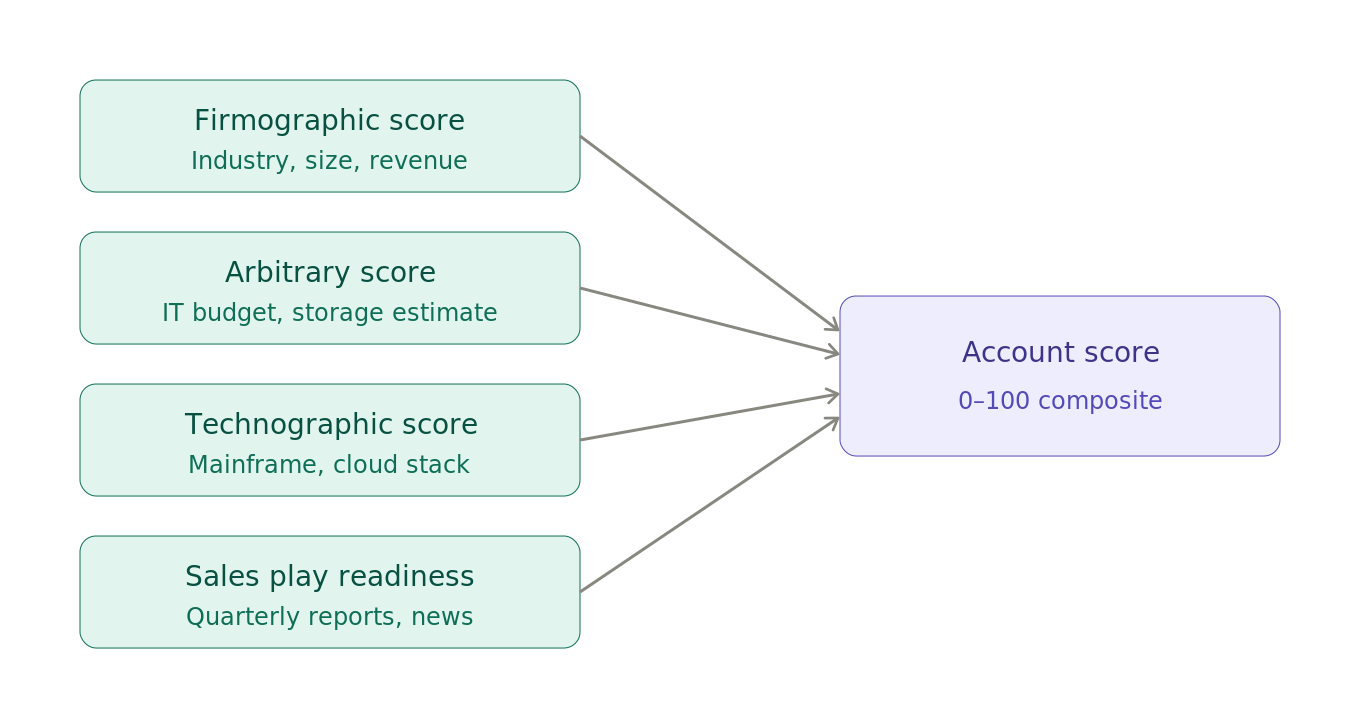
Figure 1. The four-score prioritization model. Each layer is scored independently — firmographic fit, estimated IT spend, technographic buying signals, and sales play alignment. The composite account score (0–100) is only produced when all four inputs converge. A high firmographic score without a mainframe refresh signal does not surface an account.
The Firmographic Layer
Three enrichment sources run in waterfall: ZoomInfo, HG Insights, and the native Clay enrichment. Employee count and revenue are waterfalled across all three to maximize fill rate. A small Clay agent classifies each account’s industry as focus, adjacent, or other. Those three data points (industry classification, employee count, and revenue) feed the firmographic score.
The Arbitrary Layer
Two estimates that sit outside standard enrichment. IT budget is calculated as a percentage of annual revenue tied to industry benchmarks. Manufacturing runs around three percent of annual revenue globally. That percentage shifts by sector, but the formula produces an estimated IT budget for every account in the TAM without requiring a data purchase. The second estimate is IT storage capacity, also generated by a Clay agent using publicly available signals. Both scores are labeled arbitrary because they are derived rather than sourced. They are still useful because they establish rough magnitude and filter out accounts where the deal size would be uneconomical even if the technical fit is perfect.
The Technographic Layer
This is where the buying window becomes structural. Any account running a mainframe attached to a cloud or an open system attached to a mainframe is a high-priority target. The mainframe end-of-life event affects a specific installed base, and HG Insights surfaces when the product was first identified, what its lifecycle looks like, and whether it is due for a refresh. A refresh signal on mainframe-adjacent infrastructure is about as strong an intent signal as this market produces. The layer also captures mid-range storage and identifies which cloud vendors the account is currently using for workloads. All of that feeds the technographic score.
The Sales Play Readiness Layer
A Clay agent runs deep account research for each target. It reads quarterly reports, public appearances, investor calls, and news. The output is not a generic company summary. It is a classification: which sales play currently fits this account best. The GSI has a defined set of plays (AI-enabled field productivity, services modernization, infrastructure migration) and the agent maps each account to the play most consistent with its current stated priorities. The score it assigns reflects how closely the account’s documented trajectory matches the conditions where that play wins.
The Monitoring Layer: The Account List Is Not the Trigger
Most teams treat a scored account list as the outbound trigger. Score the account, add it to the sequence, run the play. Umar does not do this.
The scored account list is the monitoring universe. Getting into the list means the account is worth watching. It does not mean the rep picks up the phone.
The system monitors four signals across every account in the list: website visits, job changes, quarterly report mentions, and consistent news coverage. The moment an account in the monitoring pool trips one of those signals, it surfaces in the workflow. The rep who receives the notification is not looking at a cold account. They are looking at an account that scored high enough to be worth watching, has now shown an observable signal, and has a pre-built brief telling them which play fits and why.
Only accounts showing intent receive a hyper-personalized message on LinkedIn and email via Outreach. Only accounts that open the email, reply, or view it more than once receive a phone call.
The consequence of this architecture is that the phone call is not the first touch. It is the fourth. By the time the rep dials, the account has already been scored, monitored, messaged, and confirmed active. The rep is not cold-calling. They are closing the loop on a signal chain that already identified this account as in-market.
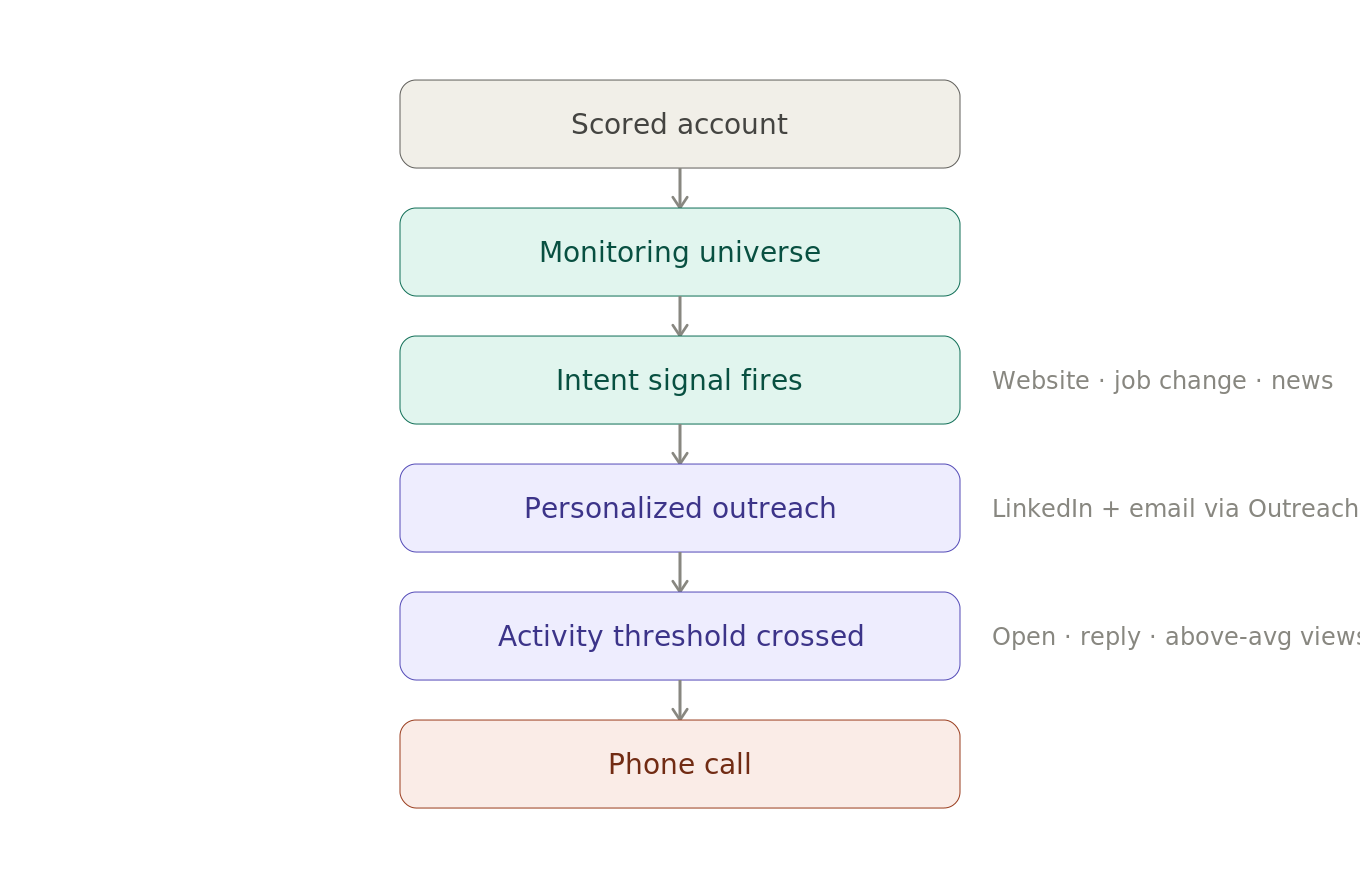
Figure 2. The signal progression from scored account to phone call. Getting into the scored list is not the outbound trigger — it is entry into the monitoring universe. Each stage gates the next. An account receives a phone call only after it has been scored, monitored, messaged, and confirmed active through engagement data.
The System Integration: How Data Moves Between Twelve Tools Without Breaking
The data architecture runs across two ecosystems that do not natively talk to each other. First-party data comes from billing, support systems, and partner networks. Third-party intent comes from Bombora. CRM activity comes from Salesforce. Sales engagement data comes from Outreach. Marketing automation runs through Marketo and Adobe Journey Optimizer. All of it gets ingested into Clay as the central enrichment and orchestration layer.
Clay does not sit at the end of the workflow as a list-building tool. It sits in the middle of a loop. Enriched data goes out to Outreach via API for message execution. Activity data (opens, replies, above-average view counts) gets fetched back from the Outreach API and pushed back into Clay. That activity data then fires a webhook that routes a rep notification to Slack or Teams, depending on which Microsoft channel the team uses. The loop is closed without a human manually checking Outreach dashboards.
The inbound motion runs off the same account list. The scored accounts that Umar’s system identified as high priority also feed the ad audience targeting. Events add another layer. Because this GSI is a systems integrator, their vendor partners invite them to a significant number of events. The event targeting pulls from the same account list. The same 300 accounts that are getting outbound sequences are also seeing ads and running into the GSI’s team at infrastructure vendor events. Inbound and outbound are not separate motions. They are coordinated pressure on the same scored target set.
The execution layer has one more structural piece that makes precision non-negotiable. The GSI does not always have internal reps making the calls. They pass the prioritized account list to preferred vendor partners in each location. Those partners run the phones, the office visits, the relationship work on the ground. When the execution depends on an external network rather than a salaried rep you can coach directly, the quality of the list is everything. A misidentified account does not just waste a rep’s hour. It wastes a partner’s credibility and the GSI’s relationship with that partner. The system has to be right before it leaves the building.
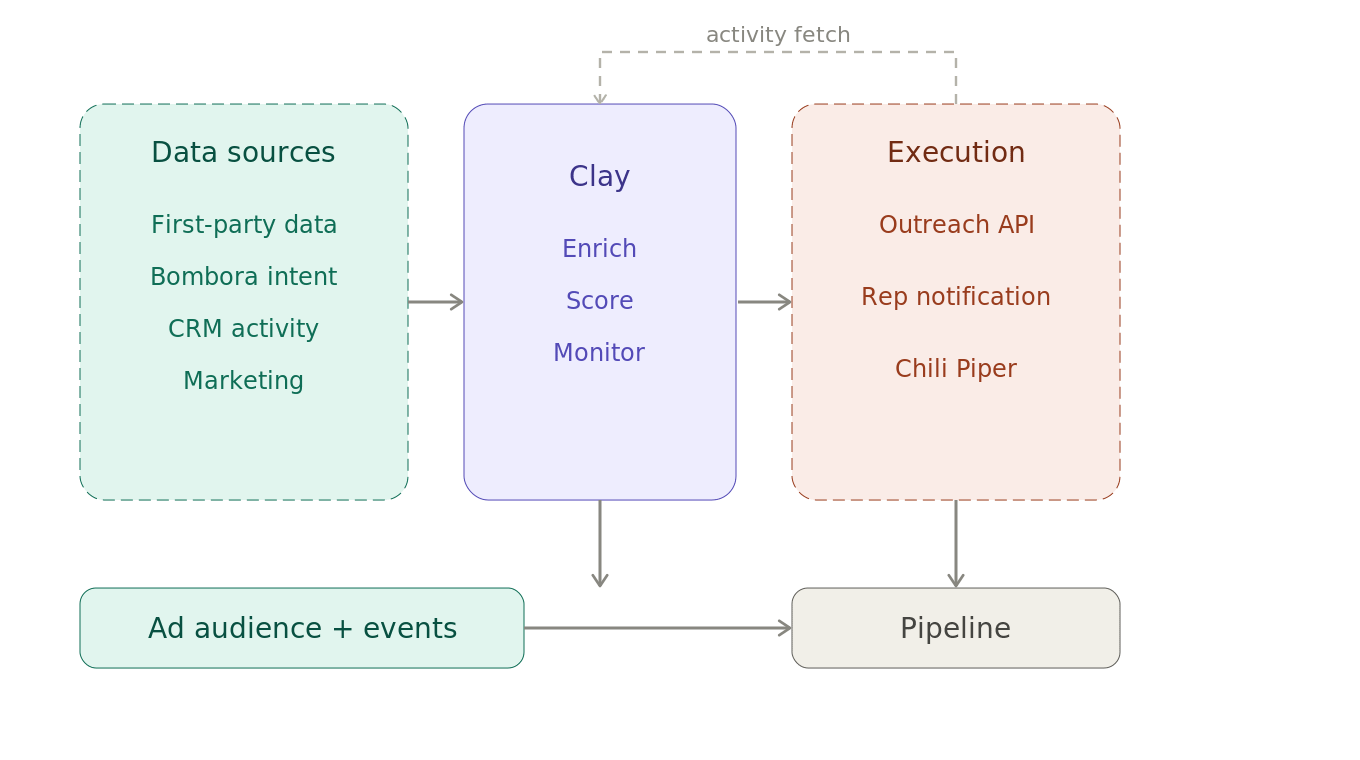
Figure 3. Full system architecture. First-party and third-party data feed into Clay for enrichment, scoring, and monitoring. Clay drives outbound execution through Outreach and routes rep notifications via Slack or Teams when engagement signals fire. The activity fetch loop (dashed) returns open and reply data from Outreach back into Clay in real time. The same scored account list powers the parallel inbound track — ad audiences and event targeting — with both motions converging into the same pipeline.
The Compression: £300,000 Down to £20,000 Per Quarter
The previous approach: a specialized research firm based in London. Annual cost of £300,000. The output was a prioritized account list that took weeks to produce and could not react to real-time signals.
The current approach: Clay, HG Insights, Bombora, the M365 suite, and the automations Umar built on top of them. Total cost: under £20,000 per quarter.
That is not a percentage improvement. It is a structural replacement. The research firm’s primary value was converting raw account data into an analyzed, prioritized list. That function now runs continuously, in Clay, at a cost that is roughly fifteen times lower on an annualized basis.
The lead time result is the sharper number. Before the system, the average time from a meeting request to a scheduled meeting with an inbound rep was seventeen to eighteen days. The reason was manual. Someone had to identify the account, pull the research, route it to the right rep, and schedule the follow-up. The system now fetches engagement signals from the Outreach API in real time. The moment a target account shows activity, a rep gets a Slack or Teams notification. The rep calls. The meeting is scheduled the same day.
Three weeks to the same day. Without adding headcount.
The alternative the GSI had been seriously considering before this system was hiring forty additional sales reps to cover the TAM manually. That path would have added significant fixed cost, introduced coordination overhead, and still relied on those reps to make good prioritization decisions without the infrastructure to support them.
The Pattern
Prioritization is not a scoring problem. It is a system design problem.
The score is only as useful as the data layer behind it. The firmographic classification, the technographic window, the sales play readiness model: those scores are not interesting on their own. They are interesting because they reflect a deliberate architecture: enrichment waterfalled across multiple sources, intent layered on top of fit, sales play classification running against real account research rather than generic signals.
The data layer is only as useful as the workflow it lands inside. A perfect account score that lands in a static spreadsheet produces the same rep behavior as no score at all. Umar wired the score into a monitoring loop, the monitoring loop into a personalization engine, and the personalization engine into a real-time notification system. The rep never pulls data. The data finds the rep.
Clay does not prioritize accounts. The system Umar built around Clay does. If your reps still open Monday morning to a list of 200 accounts and no signal about which five deserve effort this week, the gap is not at the rep level. It is upstream in the architecture, connecting your enrichment, your CRM, and the surface where the work actually happens.
Timestamps
(0:00) Intro: Umar Farooq Adam and the prioritization problem (1:23) The client: a global systems integrator, 150,000 accounts, 300 a month (2:45) The whiteboard: Clay, HubSpot, Outreach, Chili Piper, Power Platform (4:07) Monitoring the universe instead of emailing the list (5:29) The Clay table: firmographic score from three enrichments (6:11) Arbitrary scores: IT budget and storage estimates (6:51) Technographics: the mainframe end-of-life window (7:32) Sales play readiness and the 0 to 100 account score (8:56) Why the top 0.5 percent beats hiring 40 reps (10:18) Results: 15x lower cost, lead time from 18 days to same day
Find Umar on LinkedIn and see his GTM consultancy at gtmstudio.xyz. Subscribe to Show Me Your Stack for the next episode.
Show Me Your Stack is a GTM Vault series. Each episode features one operator walking through the actual system behind their outbound, their prioritization, or their pipeline motion. No slides. Just the stack.
Full transcript
Machine-generated transcript from the episode video. Speaker labels are not included and some names and product terms may be transcribed phonetically.
[0:00] Enterprise account lists are too long to work and too short to ignore. The TAM is mapped. The named accounts are assigned. Reps still spend their week researching the wrong 50 companies because nothing in the system tells them which five to actually open today. This is not a coverage problem. It is a prioritization problem mascar masquerading as one. In episode five of show me your stack, Umar Farukq Adam walks through how he solves it at global systems integrator who is focused on expanding in IMA given the cloud reparation and sovereign cloud trends. Umar started as an inside sales rep for APAC at Hitachi, built account research automations that improved his own selling and got pulled in to a lead global pilot and increased lead quality by 60% and compressed weeks of manual research into days. He now runs GTM programs globally at Hitachi Vantara. He also consults IT MSPs and ISVS with automating GTM. His stack, Clay,
[1:03] HubSpot, Chili Pepper, Outreach, and the Power Platform with the rest of the M365 suite. The unusual part is not the tools, it is how he wires them together inside an enterprise where the data lives in Salesforce, the workflows live in Microsoft, and the enrichment has to land in both without breaking either. Umar, welcome to the show. Thanks, Rick. Thank you so much for having me. Pleasure is all mine. Why don't we get right to it? Sure. Before I share my screen, I I think it would be good to have some background about the client that we that I'm working with. So, it's a it's a global systems integrator and they work on a project basis. What a system integrator does is they help integrate systems obviously and they are pushing massively in EMIA because of the sovereign cloud uh trends and the whole cloud repatriation.
[1:53] uh so they have a massive TAM and since they are project based it's very much different from a big tech or a SAS in a way that they cannot have a they cannot have outbound team consistently. So the main problem they are solving is how to consistently monitor accounts out there and only reach out to the accounts who could be in market for a you know cloud to onrem shift and just because they don't have an outbound team who can you know dial 200 accounts a day. So I got introduced to them. It's been uh it's been roughly 6 months. Took the first 2 months to just set things up. So we have two things to present today. A highlevel whiteboard workflow to show the systems integrations and then a clay table to highlight how we are actually prioritizing accounts. So they have a TAM of more than 150,000 enterprise accounts and they reach out to the top 300 accounts every month. So that's like 0.00001.
[2:53] So these are some of the tools that they are using Clay Hubspot Chili Piper outreach and then they also use the M365 suit right so we use the built-in power apps and power platform to automate some of the things that usually would need Zapier or NAN to do. So there we are ingesting first party data from their billing support and partners and also third party data from uh bomba for intent and then the CRM activity sales engagement platform which is outreach automation platform for marketing they're using markettoer and CDB AO we are ingesting all of that into clay and then enriching it further with theographics basic industry revenue size type location to make sure ICP is a good fit.
[3:40] and then technographics. So what what this SI does is they target customers who have massive footprint on cloud and then they are you know now moving to on premises solutions. So we are using edgy insights to find when a when the product was first identified what was the product's life cycle and whether they are out for a refresh which signals a very strong intent to buy. Then we are doing custom research to figure out an ID budget, storage capacity and sales per readiness. So using these we build account list and this is where it gets interesting. So a usual company once they have an account list they would just find all the IT decision makers in that list and start doing outbound.
[4:27] We are not reaching out to everyone in that account list. We are monitoring people who show up on our website, who recently changed a job, who mention something in the quarterly report or who are consistently coming up in news. Then we personalize messages on Clay and automate that sending via the outreach API directly from Clay. Once we get some sort of activity, whether the email was opened or replied or was seen more than usual, we fetch this data from the API and push it back into Clay to route it to the correct person. This is the outbound flow. For inbound, we use the same account list, build a ad audience, and they also do sometimes events. Since they are SI, they get invited to a lot of events by different suppliers and vendors and they target these same people. So inbound and outbound, it all goes back via outreach into Chili Piper, great meetings and pipeline. The main problem was how to reach out to the top 300 accounts out of a TAM which is
[5:32] 150,000. This is where I would like to show the the clay table that I built for them. So we are using three different company enrichments which is from zoom info edgy insights and the native clay enrichment to waterfall employee count and revenue data and then we are using a a small agent to classify industries whether it's uh focus adjacent or others. We're using these three data points all the graphics, industry, employee count, revenue and the type of the company to assign a graphic score. Then we have a couple of arbitrary data points which is IT budget and IT storage estimate. Now these two are not very relevant because it's um and that is why we call it arbitrary. So the ID budget is flowing through zoom info and it's usually a percentage of their total revenue depending on which industry they are from. So if
[6:34] they're in manufacturing it could be 3% of their annual revenue which is a global trend and apart from this we I also set up a clay genen to uh estimate their uh IT storage capacity using these two we assign another score then this is where the heavy lift comes in in terms of technographics. So for them, any customer who has a mainframe attached to a cloud or an open system attached to a mainframe system is a lowhanging fruit because one of the mainframe suppliers is going end of life. There were like only three players out there who used to provide mainframe systems. One is closing that business, right? So it's a massive window for system integrators and data infrastructure providers. Then we also use some mid-range storage to see we also check which clouds they're which cloud or vendors they're working with for cloud workloads. We assign another score then we use another clay agent to do deep account research based on their
[7:37] quarterly reports their public appearances to figure out which sales play currently suits them the best. Then we use this four scores technographics, thermographics, arbitrary and sales play readiness to come up with an account score which is ranked from 0 to 100 and we return with a account brief of the best suited sales players AI enabled field productivity and services why and what are they currently using right so once you do this for 150,000 accounts a quarter You will roughly find half a million prospects every quarter. Half a million prospects means 130,000 people to call an email every month. Right now, to just reach out to a quarter million people every month, you would need thousands of inboxes, a bunch of Twilio accounts, and a you know an army of 50 sales rep who are sitting on a parallel dialer. And we
[8:39] all know how bad the conversions are getting with the old outbound. It's really getting difficult to get these emails landing in primary. It's really getting difficult to get the calls connected. So we are focusing on uh pure hand raises, pure intent to figure out the top 0.5% of the accounts. Then they receive a hyper personalized message both on LinkedIn and email via outreach. And then people who you know show some sort of activity or interest they are the only ones who received a very personalized phone call from their rep. But this has really helped save time. They were going in a completely different direction of hiring uh 40 different sales reps. Right now they are just focusing on automation and passing down the positive accounts directly to their field team. One good thing with this client is that since they are a systems integrator, they work
[9:40] with a lot of vendors and usually vendors. The vendors have their own uh have their own sales team, right? So these guys at the system integrator, they just pass down the list of accounts to their preferred partner in any location and that partner would help them make phone calls, send gifts to that customer, reach out to their office to schedule meetings. So for them it was a matter of getting their targeting and positioning right which significantly helped. Before using uh clay and the whole GTM thing they were working with a highly specialized research firm based out of London they were spending 300,000 uh pounds a year. Right now this whole setup cost them less than 20,000 a quarter. So it's a 15x less cost. They don't have to hire 40 people to do what AI and automation can do. And they have seen their lead time go down by you know it was before they were having inbound
[10:44] reps it was like 17 to 18 days from getting a meeting. Right now it's the same day right the moment someone opens up the email the API fetches their activity from outreach pushes into clay the webbook fires up a rep on slack or a rep on teams automatically gets notified that hey you need you need to you know reach out to this uh customer like right now they were on your website 5 minutes ago or they downloaded an asset from your website. So it was the two biggest results were getting the cost down by 15 times and decreasing the lead inbound lead time from 17 to 18 days like literally 3 weeks to the same day. The pattern underneath the walk through prioritization is not a scoring problem.
[11:31] It is a system design problem. The score is only as useful as the data layer behind it. And the data layer is only as useful as the workflow it lands inside. Clay does not prioritize accounts. The system Umar built around Clay does. If your reps still open Monday morning to a list of 200 accounts and no signal about which five deserve effort this week, the gap is not at the rep level. It is upstream in the architecture connecting your enrichment, your CRM and the surface where the work actually happens. Find Omar on LinkedIn. Subscribe to Show Me Your Stack for the next episode. Thanks, Omar. Thank you so much.