
LinkedIn Ads Work When the List Comes From Outside LinkedIn
Bogdan Liutic, Founder at CR8
This episode is a skillSignal-based LinkedIn adsFree to download or run in Claude →On the Stack Index · 9 tools
Bogdan Liutic’s full stack, by layer →- SlackAction SurfaceAlert hub where scored accounts land for SDRs
- LinkedIn AdsChannels and ContentCompany list upload matched on LinkedIn company URL at over 90%, with company engagement exported for SDRs
- ClayEnrichment and ResolutionIn use as a baseline; Apify plus n8n preferred lately for flexibility
- n8nOrchestrationWeekly loop that merges signals into one database, scores and ranks accounts, and pushes hot ones to the team
- Claude CodeReasoningFilters the scraped vacancy CSV to ICP and formats the LinkedIn company upload
- RB2BSignalWebsite visitor identification for the soft conversions routed to SDRs
- ZenABMSignalCompany-level LinkedIn ad engagement, pulled over MCP into Claude Code or n8n for scoring
- ApifySourceCareer-site listings scraper for live demand generation vacancies, and LinkedIn ad scrapes for competitor angles
- LinkedIn Ad LibrarySourceCompetitor ads compared across 30 and 90 days to find the angles still running
Bogdan Liutic on building LinkedIn ad audiences from hiring signals, uploading companies instead of contacts, and why 1,000 accounts is the floor
Most teams run LinkedIn ads the same way. They open Campaign Manager, set company size, industry, region and job title, push a "book a demo" ad, spend $1,000 to $5,000, and conclude that LinkedIn is too expensive for their niche. The channel is not the problem. The filters are. The signals that say a company is ready to buy live outside LinkedIn, and the native targeting cannot see them.
“I don’t really trust LinkedIn only filters.”
Meet Bogdan Liutic, founder of CR8, a LinkedIn ads and ABM practice in Berlin. He has spent 14 years in go-to-market and built two businesses to seven figures. He joins Show Me Your Stack for episode 11 to walk through the one flow his agency runs: build the account list from hiring signals, upload companies rather than contacts, copy the ad angles competitors have kept running for 90 days, catch the accounts that engage without converting, and push them to SDRs while they are warm.

The stack is Apify, Claude Code, n8n, LinkedIn Campaign Manager and the LinkedIn Ad Library, ZenABM, RB2B and a Slack or Telegram alert. The tool list is not the story. The story is that every step exists to stop paying LinkedIn prices for impressions on accounts that were never going to buy.
Watch on YouTube
The full episode is on YouTube. Subscribe to the channel for the clips and cuts that never make the write-up.
The List: Build It From Signals LinkedIn Cannot See
LinkedIn has no filter for "hiring a head of demand generation right now." For CR8, that is the strongest buying signal there is: a company that has posted the role has already decided to spend on demand generation, and has decided to do it now.
Bogdan runs an Apify career-site scraper with a plain-language brief: find 200 open roles for demand generation, paid social and growth marketing managers, exclude agencies, exclude interns and coordinators. Apify returns the listings from Workable and company careers pages as a CSV. That list is still raw. He drops the CSV into Claude Code with an ICP prompt, and 200 records become 127 companies, then 52. Out went 33 companies selling to consumers, 22 agencies, 7 roles that do not own a budget, and a handful of postings with no live role behind them.
Neither of those filters, B2B versus B2C or whether the hire owns budget, exists inside LinkedIn. That is the point of building the list outside it.
A list built once serves one campaign. CR8 runs it as a weekly n8n loop: every Tuesday the workflow pulls signals from several sources into one database, scores and ranks the accounts, and pushes the hot ones, an open role plus an ICP fit plus an existing relationship, to Telegram. It could as easily be Slack or an SDR's queue. With an MCP connection, Claude Code can build the n8n workflow itself.
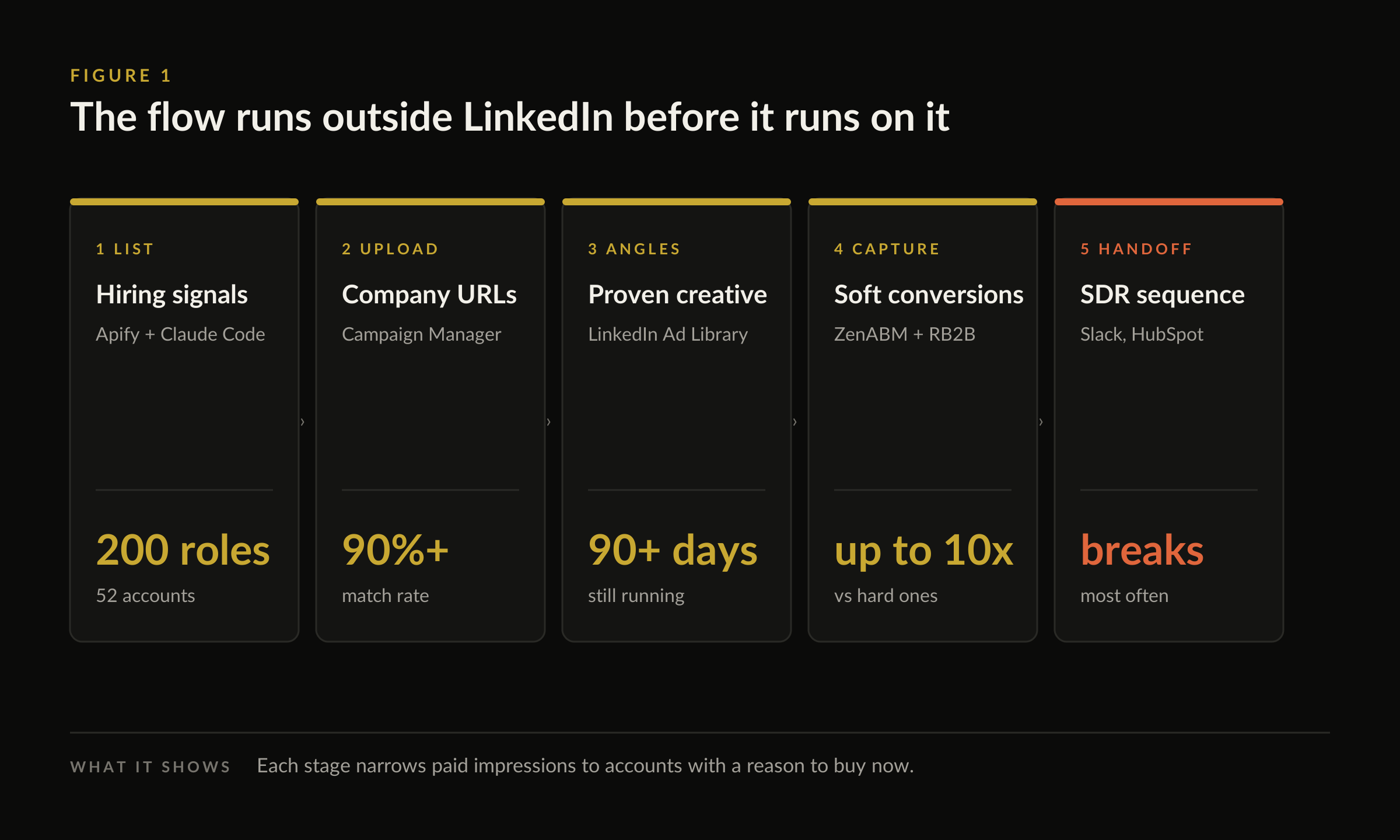
Figure 1. Every stage of the flow exists to keep paid impressions off accounts that were never going to buy.
The Upload: Match Companies, Then Filter Titles
LinkedIn is the only major ad platform that lets you upload a list of company URLs and target the people inside them. You can upload companies or contacts, and contacts look better on paper.
They do not work in practice. Contacts match on the email a person registered with LinkedIn, and very few people register with their current work email. Tools like Clay try to brute-force it by trying every work and personal address on record, and the match rate stays low. Company lists match on the LinkedIn company URL, which is easy to find, and CR8 sees match rates above 90%.
So CR8 uploads companies and narrows with titles inside Campaign Manager: for a finance product, the CEO, the CFO, the head of finance and the finance manager. Four or five people per account. When both the company and the title fit, the audience is small and hot.
The Floor: Why 300 Accounts Is Not Enough
LinkedIn accepts a company list as small as 300 accounts. CR8 will not test below 1,000.
The arithmetic is simple. Three hundred accounts with five titles each is an addressable audience of 1,500 people, and only a few hundred of them are on LinkedIn on any given day. LinkedIn ads are sold by auction, so a tiny daily audience drives the cost per thousand impressions up sharply. A thousand accounts gives roughly 5,000 people and around 1,000 active each day, enough to test. Ten thousand accounts, roughly 50,000 people, is the level CR8 scales at.
The test has one number attached. "I don't care what's your impression about LinkedIn," Bogdan says. The target is a lifetime value to acquisition cost ratio of at least 3 to 1, and at small list sizes the CPM alone can make that impossible.
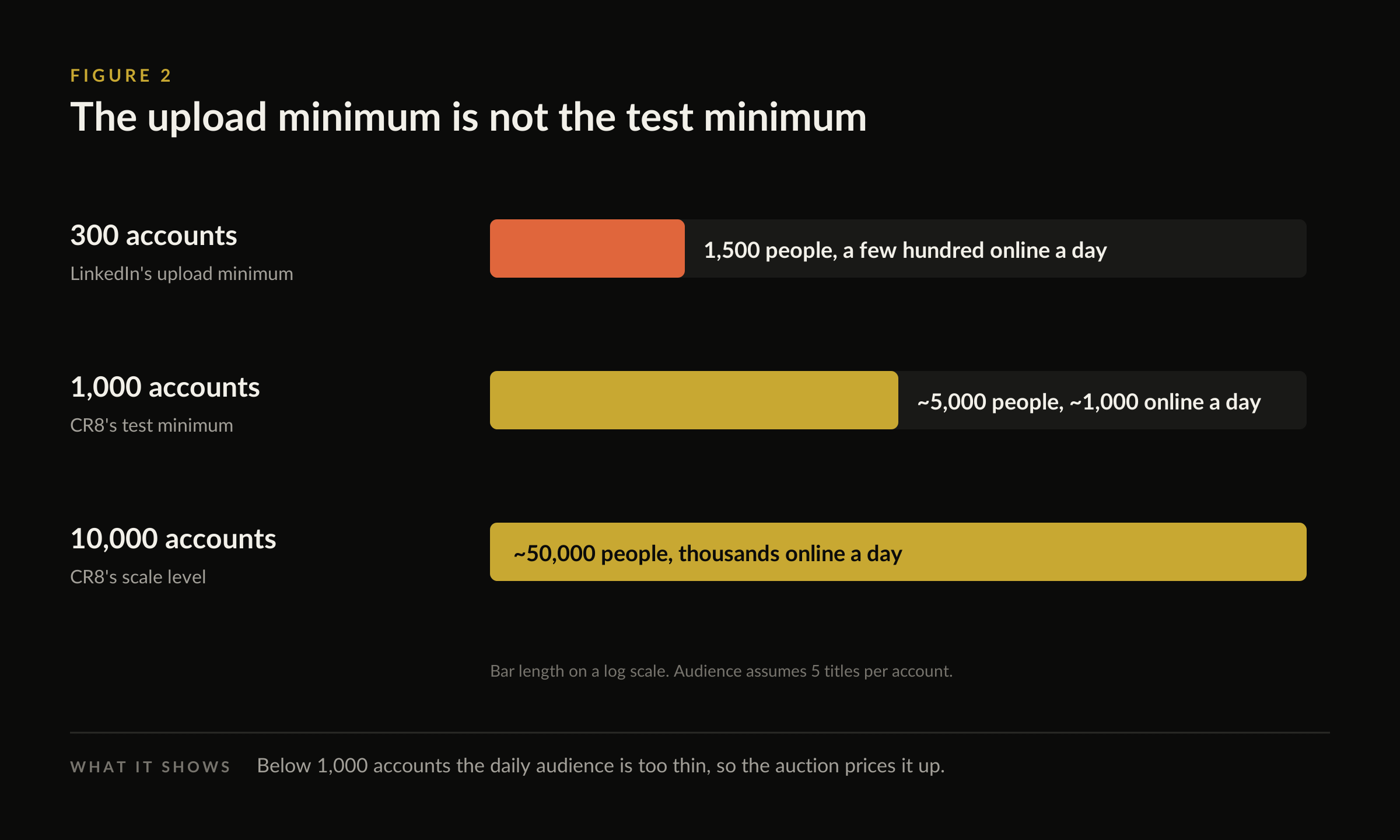
Figure 2. The upload minimum is not the test minimum: below 1,000 accounts the daily audience is too thin to price.
The Angles: Copy the Ad That Has Run for 90 Days
CR8 does not invent ad angles. "You don't have to be a genius to figure out which angles for ads works," Bogdan says. "You just have to know what your competitors are running long enough."
The LinkedIn Ad Library shows every ad a company has run, filterable by country and date. Search a competitor for the last 30 days, then for the last 90, and compare. An ad still live after 90 days is very likely producing pipeline, because nobody keeps paying LinkedIn rates for an ad that does not. For ads served in European countries, the library also shows impressions and targeting.
Doing this by hand works. CR8 runs it through an Apify ad-library scraper instead, by keyword, region or company, which returns the creative and the copy at scale. The rule is to take the angle that has survived, improve it, and test 10 variations of that angle rather than gambling on a new one.
The Capture: Soft Conversions Outnumber Hard Ones Up to 10x
A senior buyer on a $50,000 to $100,000 contract rarely fills in a form. They see the ad, click through to the site, and leave. Across CR8's clients, these soft conversions run up to 10 times the hard ones. "If you don't catch people who are on your website, who are engaging with your ads... you're losing 90% of the potential lead grab," Bogdan says.
CR8 catches them three ways. LinkedIn shows which companies engaged with each campaign, with impressions, clicks and CTR per account. ZenABM pulls the same LinkedIn engagement data, and because it runs over MCP, Claude Code and n8n can move it into other systems. RB2B de-anonymises website traffic. An account inside the ICP with 20 engagements from its decision-makers goes to an SDR now, rather than waiting for it to convert on its own.
The scoring is where it breaks. A prompt that asks a model whether an account "fits the ICP" drifts. CR8 boiled the judgment down to numbers, and that is what made the scoring hold.
Where This Goes: The Work Ends at Revenue
The biggest failure in this flow is not technical. Across clients, the leads get caught and pushed into Slack and HubSpot, and then nobody reaches out to them. His message to GTM engineers is blunt: "Your work doesn't end when the lead is in, your work ends when the revenue is in."
A soft conversion needs a cold sequence, not a single inbound reply: calls, LinkedIn messages and emails in a defined cadence, owned by the SDR lead. Bogdan prefers Apify plus n8n over Clay for the flexibility, though he uses Clay as well, and his bet is that the agencies that win on LinkedIn will be the ones that own the handoff as tightly as the targeting.
The Pattern
LinkedIn ads are expensive because the audience is valuable. The mistake is paying that price for impressions on accounts that show no sign of buying.
Build the list from signals outside LinkedIn, match companies rather than contacts, copy the angles that have survived 90 days, and treat engagement as a lead.
The rule: target hard enough that every impression lands on an account with a reason to buy now.
Worth stealing
- Use open roles as the buying signal. A company hiring the person who would buy from you has already approved the budget. Scrape the postings with Apify and filter them to your ICP with Claude Code.
- Upload companies, not contacts. Company URLs match above 90%. Contact uploads depend on the email someone registered with LinkedIn, which is rarely their work address.
- Test at 1,000 accounts, scale at 10,000. LinkedIn accepts 300, but 1,500 people is too thin a daily audience to price. Below 1,000 accounts the CPM alone can break a 3 to 1 LTV to CAC target.
- Copy the ad that has run for 90 days. Compare a competitor's last 30 days against the last 90 in the Ad Library. What survived is working, so improve that angle instead of inventing a new one.
- Treat engagement as a lead. Soft conversions run up to 10x the hard ones. Pull account engagement from LinkedIn or ZenABM, de-anonymise visits with RB2B, and route the ICP fits to SDRs.
- Score with numbers, not prompts. A model asked whether an account "fits" drifts. Turn the judgment into numeric criteria before you automate it.
Timestamps
(0:00) Trailer and intro
(1:34) The flow: LinkedIn ads for $10K+ ACV and director-level buyers
(4:07) Why LinkedIn filters miss the buyers, and the hiring signal
(6:53) Filtering 200 job posts to 52 companies with Claude Code
(8:39) The weekly n8n signal loop
(9:58) Company list versus contact list uploads
(14:54) Finding proven angles in the LinkedIn Ad Library
(20:37) Soft conversions, ZenABM and RB2B
(24:33) Where it breaks: the SDR handoff
(26:43) Why 1,000 accounts is the minimum
On the record from this episode: Apify, Claude Code, n8n, LinkedIn Ads, RB2B and HubSpot. Each links to the operators who run it on The Stack Index.
Links
Follow Rick on LinkedIn - https://www.linkedin.com/in/rickkoleta/
Follow Bogdan on LinkedIn - https://www.linkedin.com/in/bgdn/
Visit CR8 - https://cr8.eco/
GTM Vault on LinkedIn - https://www.linkedin.com/company/gtmvault
Previous episodes include
SMYS 10 | The Expensive Campaign Is the One You Never Ran
SMYS 9 | The First Thing a Signal Agent Does Is Throw Signal Away
SMYS 8 | The Browser Is the Interface Everyone Abandoned
If this was useful, hit like and restack.
This newsletter was written and edited by Rick Koleta.
Show Me Your Stack is a GTM Vault series. Each episode features one operator walking through the system behind their outbound, their prioritization, or their pipeline motion. No slides. Just the stack.
Full transcript5,994 words · open to read or search
Full transcript of Show Me Your Stack episode 11, lightly edited for readability: names and product names corrected. Speech is otherwise as spoken, and timestamps refer to the episode video.
[0:56] Rick Koleta: All right, welcome back to the Show Me Your Stack show. Today we have Bogdan Liutic on air. Welcome, Bogdan.
[1:06] Bogdan Liutic: Thank you, Rick. Thank you.
[1:06] Rick Koleta: Bogdan's joining us from Berlin, Germany. He is the founder of CR8, which is a boutique ABM and LinkedIn ad agency. Bogdan, do you wanna take over the show?
[1:22] Bogdan Liutic: Yeah, absolutely. Thank you, Rick, for for introduction. Just to give your viewers a bit of the context where we go today, right? So, what I want to do is to show the flow, which is very specific flow and this is the only flow we're working on, which is LinkedIn ads flow focused on demand generation for very specific ICP, which is if you sell some service or
[1:50] Bogdan Liutic: SaaS product with the average contract value more than 10,000. If your ideal client persona would be director level plus at the companies who and the total addressable market is bigger, let's say than just maybe S&P 500. Let's say you have 1000 companies and plus in your total addressable market. This is the flow which will help you generate this what
[2:21] Bogdan Liutic: so-called black box where you put one dollar in and get one two dollars out, right? So the the black box for for the ROI. I believe LinkedIn ads is one of the most misunderstood channels in the B2B there is. And there is a good kind of reason for that being LinkedIn ads are expensive, right? So like everybody knows LinkedIn ads are are crazy expensive. It's one of the most expensive channels there is, but I believe there is a good reason for that. The executive audience for this
[2:49] Bogdan Liutic: exactly as I said, director plus are there. You can target them there. You can get them there. And I believe that if you have a chance to be in front of your very specific decision makers versus a broad audience, you want to be there. It makes perfect sense, right? It's pretty straightforward from the first principle perspective. Now, if you are there, if it is expensive, what you want to do is you want to target hard. You want to target as good as possible. You wanna don't want to spend any
[3:18] Bogdan Liutic: zero impressions on people who are not your ICP, who are not ready to buy, who are not in your in your very specific thing. So from that perspective, what I the approach I'm taking, which is different from the approach you would see usually, because usually you go to LinkedIn ads, you go into the filters, you have okay, size of the company, industry, geographical area, role in the company, push the ads to them, which is usually ads around the lines of hey, book a demo with us, book a consultation, free consultation, 30 minutes.
[3:44] Bogdan Liutic: Right, you spent maybe a thousand, maybe two thousand, maybe five thousand dollars. Don't get too much out of this. Say LinkedIn ads suck, too expensive, and doesn't work for my niche, move on. This is very, very, very usual case for that. I believe there are several things that are very specifically should be done differently. One of them is list building. I don't really trust LinkedIn only filters. The filters which are on LinkedIn, I I don't think.
[4:13] Bogdan Liutic: Those are the best filters you can use for generating your audience. And here is why. The best things are outside, the best information about the companies, which signals they're ready to buy from you specifically, is outside of the LinkedIn. So, for example, this is an example here, and I will show you how I usually grasp this because I know your audience is a bit more tactical. They want to know how it's grasped.
[4:42] Bogdan Liutic: If company, for example, yeah, you have the right size of the company, right, right, whatever, everything, size, geographical area, title within the company, industry. But what about company who are specifically hiring very specific role? I'm talking right now about my ICP. And for me specifically, for my agency, the companies who are hiring right now demand generation person within this specific geo area and size of the company are the companies who are ready to invest money into demand generation.
[5:10] Bogdan Liutic: That makes sense. They already made a decision. So you all make a decision. I'm ready to pay salary and I'm ready to do it now. Now, how to get those companies? You cannot do it through the LinkedIn filters. There's no filter like hiring right now for head of demand generation. But they are hiring. That means they have vacancies posted. There's this first service called Apify. Rick, are you familiar with Apify?
[5:32] Rick Koleta: Yeah, yeah, of course.
[5:36] Bogdan Liutic: Apify is big. I'm a huge big fan of Apify. For the ones who don't know, Apify is a marketplace of scrapers. So if you want to scrape anything from anywhere, Apify would be one of the best places to go. Because it's not necessarily a service per se. This is a lot, a lot, a lot of different scrapers for different purposes. One of them would be this one, which I use quite a bit, which is a career site listings scraper. Meaning what I say here is, hey, can you please go?
[6:04] Bogdan Liutic: And here here was my input here basically. Can you find for me 200 vacancies which are not from agencies which right now today is looking for demand generation, paid social manager, growth marketing manager, etc. Not interns, not you know, working student coordinator, etc. Give me 200 of those. And here is the output, right? So it went there, it scraped the vacancies from different websites, right? So like from
[6:34] Bogdan Liutic: Workable for careers websites and you can see you can see it here right you can download it as CSV you can take it out you can have it right so we have the companies who are doing this. Is this enough? No it's not right so it's not enough by itself because we want to filter them right we have just all of the companies who are hiring the demand generation manager. Now let's boil it down to the ICP filter criteria. Here is just a simple
[6:57] Bogdan Liutic: Claude work, right? Claude Code work. We have the CSV, we upload it to Claude Code, we give this this prompt. I'm not demoing it because it's pretty straightforward, right? You take the CSV, put put it in, put the prompt in, get the CSV out. If you do this on this specific list I just showed you, what you would get basically is the next while out of those 200 companies, right? you out of 200 records, we have 127 companies. 33 of those would be selling to B2C.
[7:30] Bogdan Liutic: Right. And I'm I'm not working with the companies who are selling to B2C. By the way, once again, not something you can filter in in LinkedIn by itself, B2B, B2C. This is not something you can get there. Twenty-two of those were agencies, not interested. two of those, seven of those have roles, but roles who don't own the budget, meaning that the budget not necessarily exists and which is important for us as a signal. For each of your companies would be definitely different different signals, but this is one one which is important for us.
[7:58] Bogdan Liutic: Post, for example, names but no company, future opening, no live role, okay, whatever. So out of one hundred twenty-seven, we have fifty-two very specific companies. We're hiring very specific people within very specific industries, and that fits us perfectly. This is something we want to keep, right? And this is several examples of this, right? So we have Celigo on that list as a company. Okay, they they're hiring. This is this works, B2B paid media agency competitor is out, right? And what we want to do is
[8:27] Bogdan Liutic: We want do this not only once, if you do this once, which is good for one campaign, but if you want to do this in a recurring way, it's not necessary enough to and you don't want to go and click it every time, right? So as an engineer, you want to try to automate it, at least somehow. So from that perspective, what we like to use is n8n. n8n is for the ones who don't know, is kind of service which helps you to connect a lot of tools and make a recurring loops out of those, right?
[8:55] Bogdan Liutic: Well, this is one of the loops we're running. We have a bunch of those running, but this is one of those, right? And you don't have to even make it yourself manually. If you connect an MCP, Claude Code can do it for you, obviously. But just to show you some some some stuff from the each side, for example, on Tuesdays every week, what we want to do is we want to grasp those signals from different sources. We wanna connect it in one in one database, score it and rank. And if we see somebody who is hot, meaning have the vacancy on, fits our ICP, we have the warm already some relationship with them.
[9:24] Bogdan Liutic: It pushes in my case to Telegram, because for for me it's more it works better, but it could be Slack, could be whatever, could be your SDR, and pushes to them and they're ready to reach out to them. This is just one of the examples how you can kind of make it not only once, but continue doing it recurrently. n8n plus Apify together, good combination. okay, we have the list, right? What we want to do is
[9:51] Bogdan Liutic: wanna do some LinkedIn ads, right? We wanna make sure they know about us. They have some connection with us. They saw some of our content. What you want to do is we wanna upload that list to LinkedIn, right? In order to do so, and this is why I like LinkedIn so much, why I believe LinkedIn has such a big competitive advantage. You can target very specific companies. You cannot do it on Meta. You cannot do it on almost any platforms but LinkedIn where you can
[10:16] Bogdan Liutic: Upload the list LinkedIn URLs of the companies and target people specifically on those companies who are signal-based. You already build this list together. In order to do so, you go to LinkedIn Campaign Manager. Let me just show you, show you several stuff which are interesting in here. For the people who want to do this by their own, without the direct link, you go to your campaign manager, you go to the audiences. And here we can create an audience. Basically, you want to do the matched audience, you can do this either on the company list, which we are doing right now, accounts.
[10:45] Bogdan Liutic: or on the contact list based, right? Rick, do you think what is easier to do on the contact list or on the on the company list? Company based list upload or contact list based approach?
[11:01] Rick Koleta: Well it depends on what kind of accounts you're targeting, right? So if it's a big enterprise yeah, you wanna have contacts ideally, right? because they could have thousands of of of of employees and so the more granular you can get with your targeting the more that each dollar you spend will give you a better R.
[11:29] Bogdan Liutic: Hundred percent and that's kinda the holy grail right now of of list matching. but here is the trick, here's the problem, right? With the company list upload, you can match them on based on their LinkedIn company URL, right? Reasonably easy because you you can find this URLs, you can build a list out of this, you can upload them, and you have, as you can see here, for example, company lists, more than ninety percent match rate. Awesome, kinda absolutely working. Now with the contacts, the problem becomes
[11:57] Bogdan Liutic: That you cannot match it on the LinkedIn profile URLs at all. You have to match it based on their emails. And not just emails, but the emails they registered to LinkedIn with. Now, Rick, how how do you think? How many people register with their professional email to LinkedIn of the current company?
[12:21] Rick Koleta: yeah, very l very low very very low percentage, unfortunately.
[12:21] Bogdan Liutic: Yeah. Very upsetting, very upsetting percent. I I will just tell you directly, right? There are there are tools that try to solve this, right? So you have in Clay, you have so-called Clay ads, which try to find all the emails of the people that say I want to target Rick specifically, right? I have your working email, current working email, previous working email, separate record, your some personal emails, which I can guess people have several. I have like eight personal emails, so you can
[12:47] Bogdan Liutic: Do the do the all all the personal ones, and then one of these records should fire, right? That's that's the kind of the idea, but still very hard. So from that perspective, what we want to do is to match is in our practice, best practices, match the companies. Simple. Simple, straightforward. And then within the LinkedIn ads filters, try to target the titles because there are so much titles you want to target. Very limited amount, right? So, like for example, we target CEO, let's say CFO.
[13:16] Bogdan Liutic: Head of finance and you know, financial manager. Four people, five people per company. It's not crazy much, right? So if the company fits and the title fits, that means that this is very, very high and hot list, right? Long story short, this is the list building exercise, right? You have one list which is result of the Apify, obviously, which is big list, etc. You want to clean it up and make sure it fits the format of the LinkedIn ads, which is
[13:44] Bogdan Liutic: Not very specific, just has several very very simple columns. let me show you real fast here, right? So you have this template here, which you show hey, give me the URL of the company, give me the name of the company, basically and that's it. And those data are optional, right? And you will have a good matching matching list in the end of the day.
[14:11] Bogdan Liutic: you wanna bring one list to the other list, do it through Claude Code. Once again, it's simple exercise. Just upload, make it simple to s similar to this list, it creates you a good list, you have 90% match rate. That's good. We upload it to LinkedIn, we did the first step, that works. Now then the question becomes what do you want to run on them? Right? So, like, okay, we have the people who wanna wanna run ads on, but what to run on them? Which type of ads to run on them? Now, if you wanna go into more
[14:36] Bogdan Liutic: kind of strategic thinking. I I would address you to the article on Growth Unhinged. We did very specific breakdown on different angles we do. Here for your very technical nitty-gritty guys, I will show the how you technically do this. And technically, my idea is and my principle is you don't have to be a genius to figure out which angles for ads works. You just have to know what your competitors are running long enough. So if your very specific competition
[15:06] Bogdan Liutic: 10 competitors running LinkedIn Ads, let's say eight of them running LinkedIn Ads. Some of them are running the same ad more than 90 days. High chance that this ad works. High chance that they don't run it just to run it, right? Now the question becomes how how can we grasp this? Is it even possible? It is. Let me show you how. First thing is that LinkedIn has what is called LinkedIn Ad Library. Here you go.
[15:33] Bogdan Liutic: Meaning you can see all the ads of all the people in history behind up front. So you can see all of this. So let's say we want to understand what Apple is running, let's say in in United States, right? Today. So we go to Apple, we go, or yeah, whatever, United States, right? And what they did run in the last 30 days, say, right? So I have to do done.
[16:01] Bogdan Liutic: Boom. United States done. Search. Yeah, here we go, right? This is Apple cart, right? So for example, in order to make it more accurate, you can do this. Apple.com.
[16:19] Bogdan Liutic: And then Apple here again. and here you go, right? You have the specific ads that Apple is running here, right? Some of them you see Apple commercial, okay, leasing, whatever it is, but most of them are from the Apple Apple, right? Then the question becomes: okay, this is good.
[16:39] Bogdan Liutic: This gives me some understanding of what they're running in the last 30 days. Then the question becomes what they run, for example, in the last 90 days, which we can also do here, setting up the dates, doing the 90 days thing, seeing, okay, here is what happened in the last 90 days. Okay, different ads. Compare one ads to another, you will see the ads which are running continuously in the 90 days, right? So we have the kind of difference between 90 days before and today. If what is the same, meaning they're running 90 days or more.
[17:09] Bogdan Liutic: Good. Now we can do this manually, which already is doable, but we don't want to do this manually. We want to do it very much so automatically. You wanna scrape everything we could out of this. What we use for that, as usual, we go to Apify, and Apify obviously has the same type of scrapers, but for the ads. We can scrape all the ads for very specific either keywords, geo, companies, whatever you want, right? It gives you the list, it gives you the
[17:35] Bogdan Liutic: Images, it gives you the copy, it gives you everything. Now, what you want to do with this is obviously find the angles which are working for your competitors, make it better a bit, but don't go into the other angles because these angles work. Take them, do the same as in like 10 different options and attack that angle. Once again, LinkedIn ads are expensive. We don't want to spend money on the things where we
[18:04] Bogdan Liutic: can we we can make it good from the step one, right? So from that perspective, this is our approach. This is how we do this. You can also see, for example, yeah, here is Factors, right? So this is the ad they running for a while. By the way, for some of the ads, if they're running specifically with the some European kind countries in it, you will see some more stats like total impressions, countries they run this ads on, how this ads looks like targeting, blah, blah, blah, which is also helpful.
[18:31] Bogdan Liutic: But the main thing would be okay, figure out the angles, for example, yeah, Factors. This company one of the companies we're also one of the tools in our space, for example, running this benchmark PDF, right? And we understand, okay, benchmark PDF on this topic works because they're running it for already for a while, right? It gives them leads, it's good, right? So this is the information we can get for this. Same for from Fibbler, for example, if you analyze their ads, you can see okay, they're running this angle for a while.
[19:00] Bogdan Liutic: Right, with this meme, this angle, okay. It not necessarily has to be a meme in our case, but we understand okay, the angle that attribution for the ads is some angle that works, right? Because in this case it was around attribution, specifically paid paid ads money attribution. And you can see how it works, right? You want to scrape it, you wanna build ads based on this. This works. So what do we have now? Right? We have the list, very specific signal-based list. We uploaded it to LinkedIn, we have the campaign done now.
[19:27] Bogdan Liutic: Is this enough? Conventionally speaking, you would say, yeah, it is enough. The lead should get in, the sales should attack them, or they should like book the call directly, and then everything should be awesome. in reality, what you want to build, you want to build a bit broader understanding of conversions, right? In our in our head, there are two types of conversions. One is hard conversion, we just discussed it. People who are very much so directly book the call and go with it. Now
[19:59] Bogdan Liutic: In the world where we are trying to sell something which is a bit more expensive, say 50,000 average contract value, 100,000 average contract value. So and the people who are making those decisions are maybe more senior and have more on stakes when taking the call if you don't have much time for that, and expect you to be kind of proactively on what you on how you sell things and how you approach them, don't necessarily fill up the forms. Don't necessarily booking the calls, right? But
[20:30] Bogdan Liutic: We still can see who of them engaged with your ads, who of them liked your ads, who of them clicked on your website and deanonymize that, take that as a signal, and push it to your SDRs as warm-up leads. This is what we call soft conversion. So we have hard conversion, soft conversion. From the all the cases we have of different clients in different niches, it's up to 10 times more soft conversions than hard conversions.
[20:54] Bogdan Liutic: If you don't catch people who are on your website, who are engaging with your ads, companies, etc., you're losing 90% of the potential lead grab and potential revenue from the channel. So how we do this? Let's talk technical stuff, right? First thing is engagement per company. Here is something interesting you have on LinkedIn and on LinkedIn only. Is how
[21:21] Bogdan Liutic: Well well very much so professional demographics the division on the ads itself, right? So for example, this is one of the ad sets, and I can see names of the very specific companies who engage with it, how many impressions they got, impressions being how much times we showed the ad to them, how many times they clicked, what is the average CTR, etc. This is one way to look at this. Another way, which is also I find very cool, if you go and plan companies, this is another way to kind of grasp.
[21:53] Bogdan Liutic: very technically okay who are the companies who are engaging with my ads right now. Here you go. Body, RevGenius, etc. Right? How many times they engaged, on what time frame they engaged, last nine days, whatever it is, paid impressions, paid clicks, everything, right? So say we are targeting within the very specific industry, signal based lists, very specific five titles, and we see that very specific account engaged twenty times with our ads.
[22:20] Bogdan Liutic: Rick, question to you. Twenty times engaged with the ads company, decision maker within the company. Is this a good target for the SDR versus just the cold list of companies? Is it a better better target for them?
[22:35] Rick Koleta: Yeah, I mean tw that twenty engagements if you get a list with a account that has that many engagements, you wanna prioritize that first.
[22:47] Bogdan Liutic: I mean, it just make make logical sense, right? This is just f just from the logical perspective. If you want to if you have a some lead which fits your ICP perfectly and they saw and engage with your staff, with your company at least twenty times, maybe they're better targets for the sales. Maybe it makes perfect sense to outreach to them already and not wait for them to maybe forget about you or to convert on their own. So this is the way how you can grasp this, right? This is one one angle would be from the
[23:17] Bogdan Liutic: LinkedIn Ads, you can export this, you can give it to your SDRs. It's it's very pretty straightforward. You have export button here and you can have it. Then another way to do this would be a tool called ZenABM. I I cannot log in in it because right now it is on the client account, which I I cannot show the data off for for specific reasons. But this is the screenshot specifically from them, from the account. and you can see they also grasping this data from the LinkedIn. What is cool about ZenABM is
[23:47] Bogdan Liutic: It works via MCP. You cannot do the same with the LinkedIn ads cabinet. They have the API. We can use it. So meaning that through Claude Code, you can grab grasp this data and push it into or through n8n you can grasp this data and push it in into the other sources. So this is kind of cool tool. I would highly recommend. Another interesting and cool tool.
[24:06] Bogdan Liutic: Yeah, specifically to mention today, it would be RB2B, right? The this is the tool for the anonymization of the website traffic. also highly recommend, one of the best in class. yeah. that being said, we grasp them, we push them, and then you your SDRs reach out to them. Now, for all go-to-market engineers, there I have one message. Your work doesn't end when the lead is in, your work ends when the
[24:40] Bogdan Liutic: Revenue is in. That means that that one of the and where it breaks was one of the questions Rick asked me to to talk about. Hey, hey, where it breaks actually. It then breaks the most, the biggest one, the biggest bottleneck from this flow with different clients is we are great catching that leads, pushing them into the as into the Slack, into the HubSpot, and nobody reach out to them. In the end of the day, the question is to you who are those leads, why and and what
[25:06] Bogdan Liutic: Is the channel working in the end of the day? That would be the question. Now, this kind of working together would be the most important bottleneck you have. Now, in order to make this work, you have several instruments. Obviously, you want to work with the lead of the SDR team. You should have a cold flow, cold sales flow, which is not the same as warm inbound flow, meaning you are not one email.
[25:27] Bogdan Liutic: will not cut it, right? One email sending one email to the a soft conversion will not cut it. You have to be more proactive. You have to call, you have to write for LinkedIn, you have to write emails, you have to have a sequence and stuff like that. Not to go too deep into the boots, but the idea that would be one of the biggest, I would say the the biggest and and bottlenecks. Handoff to the to the sales team. Now from the technical perspective, what I want to also focus on is the coming back to the message of LinkedIn as being expensive.
[25:58] Bogdan Liutic: By expensive, by the way, what we mean by expensive is the high CPM. CPM is cost per thousand impressions. How how much we pay? Just to show the ads 1000 time to the people, right? And LinkedIn would be would be the more expensive. Now, the smaller the list, the more expensive it even gets, right? It can get up to 153, you know, to to the name list of of five thousand people. Now, this is just from our accounts, right?
[26:27] Bogdan Liutic: On another list, it could could go down to 70 just by by extending it a little bit, right? The idea here is you want to build a sizable list. That means that not always you will have a list which is full of very much so signal accounts. You have to extend it a little bit. From our practice, the very minimum we work with is 1,000 accounts per upload. That means that let's say we have five decision makers and 5,000 people within the audience.
[26:53] Bogdan Liutic: Smallest amount for the test, smallest. If you wanna scale, you wanna have ten thousand accounts, which leads to around fifty thousand people in the audience, then you can scale and you can work with it. So thinking about
[27:05] Rick Koleta: A thousand accounts. I wanna I wanna I wanna stop you there. why why that's that's that's fairly above the minimum. Why minim why why is that your minimum
[27:18] Bogdan Liutic: It is. It is. It is. So so the minimum would be 300, right? So the minimum accounts you can upload on LinkedIn is 300. Not lower than 300, 300 minimum. Now, why 300 is not enough? Let's say it is some case you're selling, say, financial services, right? For the startups. You are targeting within those accounts, let's say five people, right? This is your boardroom, right? You have the CFO, director of finance.
[27:45] Bogdan Liutic: maybe some operational manager, five, five titles, right? So 300 companies, five titles, you will have the total address per market of five thousand of 1,500 people. 300 multiplied by five. 1500 people don't sit on LinkedIn every day, as you can imagine, right? So like nobody does. So let's say out of those, actively you will have like several hundred people online in each separate day. That will drive your cost per thousand impression aggressively up.
[28:13] Bogdan Liutic: Because ads working on the auction type, right? Who pays the most for the eyeballs will get the eyeballs basically. So it will go aggressively up. That's why at least 1000 would would be 5,000 people and around 1000 people every each day, more or less, right? online actively for a test, meaning for because for us the test would be once again, very technical person I am, right? I want numbers. I don't care what's your impression about LinkedIn.
[28:42] Bogdan Liutic: I wanted to understand, I want to drive it to one number. One number for us would be client acquisition cost to lifetime value ratio. Can we get more than three? Right? Can we get three dollars from the client, which cost us to to catch at least for one dollar, right? So this ratio should be three to one at least or or more. From that perspective, it g it boils down to the CPM in the end of the day. So the for the test of that, of that ratio, one thousand would be okay.
[29:10] Bogdan Liutic: Ten thousand, meaning fifty thousand people in the total addressable market, which is thousands of people online every day, would be good enough to scale this. Does it make sense?
[29:22] Rick Koleta: Yeah, yeah, of course. Thanks.
[29:26] Bogdan Liutic: That would be the audience size, and other things would be yeah, quality of the list, and obviously for the scoring, right? So when we catch people here with different signals, okay, they engaged, they were on a website, we scraped the the posts as well, right? They engage with the post. Obviously, what we want to build is the machine that grasps those signals, push them all together, and analyze if this is ICP fit and and only pushes to the SDRs what is the ICP fit. Otherwise, you will get the messages, hey, your leads suck.
[29:53] Bogdan Liutic: your your system sucks, this doesn't work from SDRs specifically. From that perspective, we use once again n8n for that because it's multi-step process. This is more or less more or less one of the flows how it looks like and yeah this flow relies on your judgment which you set up within the thing itself meaning data sources is one thing ZenABM helps you grab one thing RB2B another thing third thing from the from the third source Apify but then you have to somehow
[30:21] Bogdan Liutic: give it a prompt how to analyze this. We found that it breaks often just based on the on the judgment of okay, what is ICP fit, purchase or not. So we try to kind of boil it out to the numbers. Then it works the best. that'd be it. So we we built a very smart signal list, we built the ad campaign to warm up, we catch the engagers, analyze, push it to SDRs, and that's the whole flow without jazz, very technical, very specific. Rick asked me
[30:52] Bogdan Liutic: about Clay as well. Let me let me talk about that for a second bit. Clay is awesome. We use Clay as well. Lately I like building combination Apify n8n a bit more just from the flexibility perspective. but Clay would be a a good a good baseline as well. So just n nothing against Clay. I'm actually participating in Clay hackathons l like Clay. Clay is amazing. For our purposes we love
[31:21] Bogdan Liutic: a bit more flexibility.
[31:25] Rick Koleta: Cool. And so can you just run down your stack for well all the tools in the stack? there we go. Cool.
[31:33] Bogdan Liutic: Yeah. Yeah. Yeah. So here we go. So we're fine with Apify, filter with Claude Code, Campaign Manager for the upload, but also ZenABM for the upload. They they launched this MCP lately, works pretty good. Competitor ads with the Apify or manually or Ad Library. Hold on, LinkedIn, we can take either from Campaign Manager or Apify or ZenABM. RB2B also comes here. Record alert hubs for Slack.
[31:55] Bogdan Liutic: Obviously you can use your CRM, it is that's why it's flexible, right? We can connect any type of stuff there and n8n as a plumbing orchestration tool, etcetera.
[32:12] Rick Koleta: Perfect. Thanks, Bogdan. There you guys go. It's a flow to run signal-based LinkedIn ads.
[32:18] Bogdan Liutic: It is. thank you very much, Rick. if any of you guys would feel like okay, this flow makes sense and you would like to build a map out of this. What type of signals will fit for you? How this campaign could look like for you, how the grasping could look like for you as one map as a one flow. At cr8.eco we run these flows for
[32:39] Bogdan Liutic: For the companies who are specifically focusing on LinkedIn, have the ACV more than 10,000 and ready to invest in LinkedIn ads, happy to
[32:49] Rick Koleta: Perfect. Thanks, Bogdan.
[32:55] Bogdan Liutic: Thank you. Thank you, Rick.