Library/GTM Vault Podcast 50
The Next Buyer of Your Data Is Not a Person
Yoni Tserruya rebuilt Lusha for agents that query live, because a third of a static list is wrong by the time the last rep touches it
The list was exported, the sequence was loaded, and the reps worked it for three weeks. By the time the last contact was touched, a third of the data was already wrong. That decay rate was tolerable when humans worked lists over weeks, because a rep sees the bounced email and flags it. It is fatal when agents work signals in seconds, because the agent does not know the data is wrong. It acts on it.
The entire contact data industry was built for the tolerant version of that buyer: a person, in an interface, self-serving through a slick UI. Yoni Tserruya spent ten years winning that market. A few months ago he watched SDR and BDR agents go into production at customer accounts, doing certain work better than the humans they sit beside, and concluded the buyer of his data is about to stop being a person.
This is not a data quality story. Quality was always the product. The hard part is that the customer consuming the data is losing the ability to notice when it is wrong, which changes what a data company has to be.
Yoni Tserruya is the co-founder and CEO of Lusha, which he started as a side project in 2016 and bootstrapped for years before scaling it into one of the largest B2B contact data platforms in the market. Ten years in, he is rebuilding it as the layer AI agents query live: a verified provider in Clay’s ecosystem, waterfalls with Scale Stack, extensions inside Claude and ChatGPT, and a decision-makers API built for machine callers. He is explicit about the stakes: the agent is becoming the future persona of the data.
In GTM 50, Yoni breaks down why the buyer of contact data is stopping being a person, what survives of a ten-year-old product when the interface stops mattering, how waterfalls reset vendor economics, what an agent needs from a data vendor that a human never did, the two-layer retrofit forcing a ten-year-old company into the AI era, and how Lusha’s own GTM went headless.
This is not a conversation about data vendors. It is a conversation about which parts of your GTM system have to be true at the moment an agent acts.
Inside this episode
This episode maps what happens to the bottom layer of the GTM stack when the thing consuming it changes species.
Yoni opens with the inflection. It was not a keynote, it was production: a few months ago, early-adopter customers started running SDR and BDR agents live, trusting them with work they used to give reps, and seeing results. The majority of the market is not there, but enough early adopters are that he treats the next one to two years as the window in which agents become the real persona of his data.
We go deep on what breaks when the buyer is a machine. When a human worked the list, wrong data got caught: the rep knew it was wrong and flagged it. Put an agent on bad data and the damage is bigger and the detection is slower, because nothing in the loop knows to be suspicious. His conclusion runs against the commoditization story: inside a waterfall era, accuracy matters more, not less, and customers who need compliant, trusted data still pick their vendors carefully.
We cover the rebuild. Lusha won its first decade on two things, data quality and a self-serve UX simple enough that any user could log in, start free, and buy alone. The second thing is now irrelevant. If customers consume the data through Clay, Claude, or their own agents, they may never see Lusha’s interface again, so the product is being rebuilt as API and MCP based, integrated everywhere, chosen by machines on quality rather than by users on feel. He calls it a different way of thinking about the whole business, and it is still in progress.
We cover waterfall economics from the vendor’s side of the table. Waterfalls are the natural end state, one orchestrator stacking providers where customers used to buy three vendors and manage the mess themselves, and Yoni expects everyone to have one eventually. Lusha’s answer is to be agnostic and be everywhere: Clay, Claude, n8n, Make, Zapier. He is direct about the trade inside someone else’s waterfall: Lusha typically wins on quality and coverage, loses on price, and starts at forty-nine dollars a month, which he frames as quality any company can afford.
We go into agent-to-agent selling. When a buyer agent meets a vendor agent, both arrive having read everything public, so the discovery call dies and the conversation goes straight to pricing, integrations, and the needs that are not on the open web. The spam-to-spam worry gets the same answer: detection improves in parallel with generation, phones already screen callers, and the thing that passes the filter is a relevant reason for the contact. Laser-focused targeting stops being best practice and becomes the only thing that works.
We cover the retrofit, which he is honest about being harder than starting fresh. It runs on two layers, making the product AI-ready and making the organization AI-powered, and both are iterative and never finished. The mechanisms are concrete: every employee gets access to the AI tools they need, all-hands sessions share AI initiatives across divisions, and a team called Builders for Builders ships internal skills other teams adopt. The sharpest move is the constraint: where a team resists adoption, he shrinks the team while holding the workload constant, so AI becomes necessary rather than optional. There is no playbook and no expert to hire, because, as he puts it, eight months ago nobody was talking about Claude eating the world. The asset is a culture where trying and failing is cheap.
We go into how Lusha runs Lusha. Everything dogfoods: lead scoring, enrichment, prioritization, outbound, and churn risk all run on Lusha’s own data. The stack is going headless. The AEs almost never open Salesforce anymore, working instead from a custom dashboard that aggregates Salesforce, Lusha, outreach, and back office data into one view that says who to target and why, with engagement and call transcripts summarized and written back automatically. He expects go-to-market to go headless at more companies for the least glamorous reason available: it is a simpler operation.
We cover the pressure test. Operators are killing six-figure ZoomInfo contracts with Clay-native stacks, and Yoni’s answer is that Lusha was never the six-figure trap: it is usage-based, pay-as-you-go, bottom-up PLG. The position he claims against Apollo, Clay, and ZoomInfo simultaneously is the context layer feeding every agent in the market, including for SMBs. The LLM absorption question gets his most specific answer: a model can find five or ten contacts on the open web, it cannot return five thousand sorted, trusted results, because that requires a database designed for GTM. Claude and ChatGPT extensions already route those queries to Lusha. Compliance, he argues, is both moat and tax, and more moat, because very few companies can serve data compliantly at all.
We close on 2028 and the rapid-fire section. Reps today spend twenty to thirty percent of their time with customers; two years out he expects fifty to sixty, with agents absorbing the research, sequencing, and admin, quotas rising as manual work falls. Rapid fire lands API adoption as the underrated metric, transcripts and call recordings as the most overrated capability in revenue AI, company data as the next commodity, start small and iterate fast as the habit, and one sentence completed without hesitation: in three years the static lead list is irrelevant.
Watch or listen now across YouTube, Apple Podcasts, and Spotify
Discussed in this episode
(0:00) Cold Open: A Third of Your List Is Already Wrong
(2:58) The Moment the Buyer Stops Being a Person
(4:51) What Survives When the Interface Stops Mattering
(6:11) Waterfall Economics From the Vendor Side
(9:31) Agent to Agent Selling, Step by Step
(12:44) Spam to Spam, and the Relevance Filter
(14:24) The Two-Layer Retrofit of a Ten-Year-Old Company
(20:38) How Lusha Runs Lusha: Going Headless
(23:02) The Pressure Test: Apollo, Clay, ZoomInfo, and the LLMs
(26:10) The 2028 Revenue Team and Rapid Fire
Key takeaways
-
The buyer of GTM data is stopping being a person, and that is an architecture event, not a marketing one. The moment agents became the entity consuming contact data in production, the product requirements changed: API and MCP replace the interface, machine trust replaces user feel, and the vendor gets chosen by whatever the agent’s orchestrator ranks highest on quality. Everything downstream of that sentence is product strategy, which is why Yoni calls this the biggest evolution in Lusha’s history rather than a feature release.
-
Bad data compounds faster through a machine than through a rep. A human catches the wrong title and the dead number, flags it, and the damage stops. An agent executes on the bad record at full speed and the failure surfaces later and larger, because nothing in the loop knows to be suspicious. This inverts the commoditization story: as agents take over execution, accuracy gets more valuable, not less, and the waterfall makes the quality ranking explicit on every call.
-
Half of what won the last decade is now worthless, and knowing which half is the game. Lusha’s first decade ran on data quality plus a slick self-serve UX. The UX half is dead weight in a world where the customer may never open the interface. The discipline worth copying is the willingness to name which historic strength no longer matters and rebuild around the one that does, while the business still runs on both.
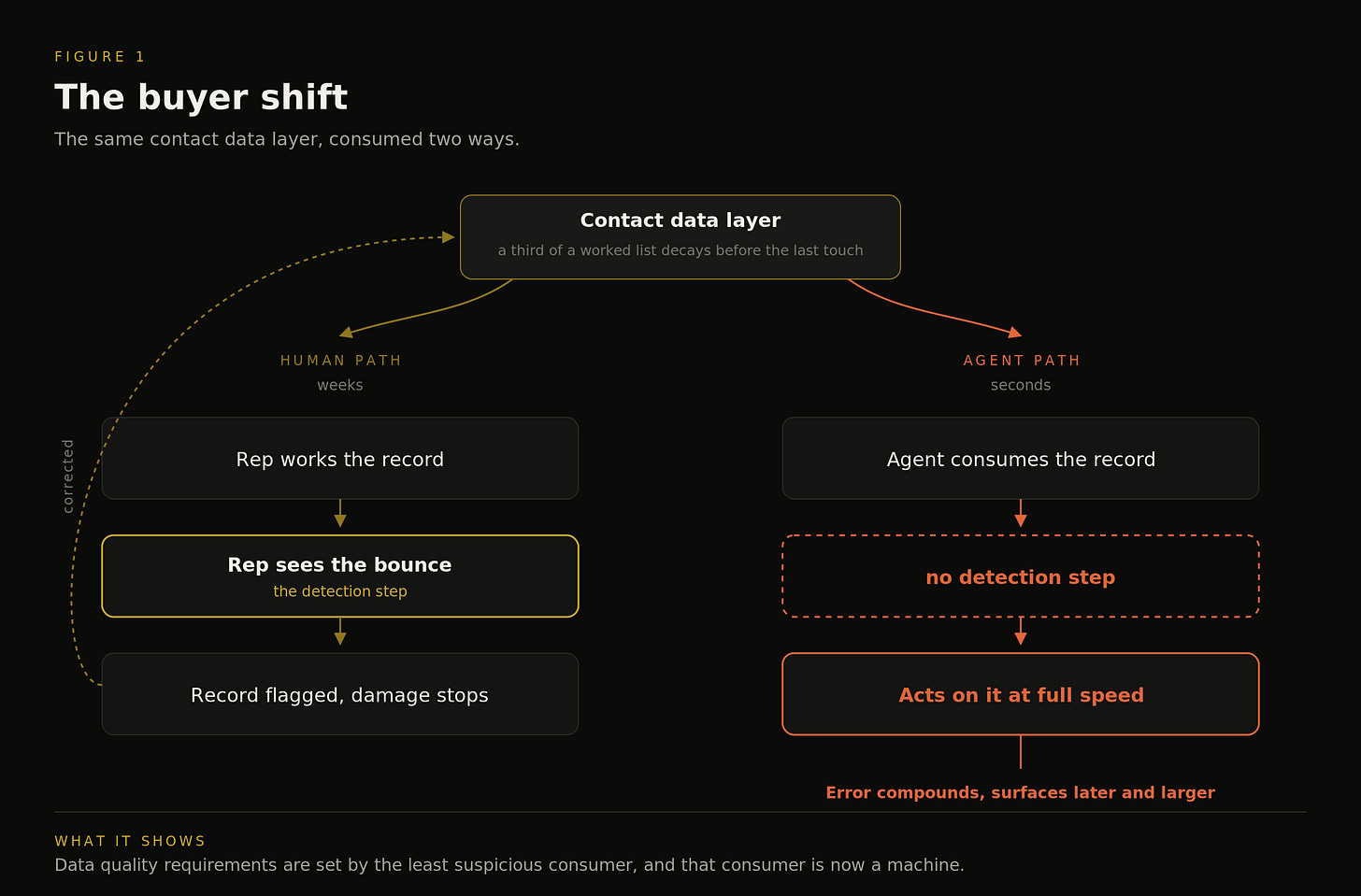
Figure 1. Same record, two consumers. The difference is not speed, it is the box that is empty on the right.
-
Everyone will have a waterfall, so position inside all of them. Fighting the orchestration layer is a losing move; being the highest-quality provider inside every orchestrator is a durable one. That means Clay, Claude, n8n, Make, and Zapier equally, winning on quality and coverage, losing on price, and saying both halves out loud. The honest trade is the position.
-
The retrofit is a forcing function, not a memo. Two layers, product and operations, both iterative and never finished. The mechanisms that make it real: universal tool access, all-hands AI show-and-tell across divisions, a Builders for Builders team shipping internal skills, and the constraint move of shrinking resistant teams while holding workload constant. Culture that makes failing cheap substitutes for the playbook that does not exist.
-
GTM is going headless, and the reason is boring: it is simpler. Lusha’s AEs stopped opening Salesforce because one custom view aggregating Salesforce, Lusha, outreach, and back office data answers the only question that matters, who to touch next and why, with context written back automatically. The suite interfaces become databases underneath an operator surface. Expect this at any company where reps cross more than three tools to answer that question.
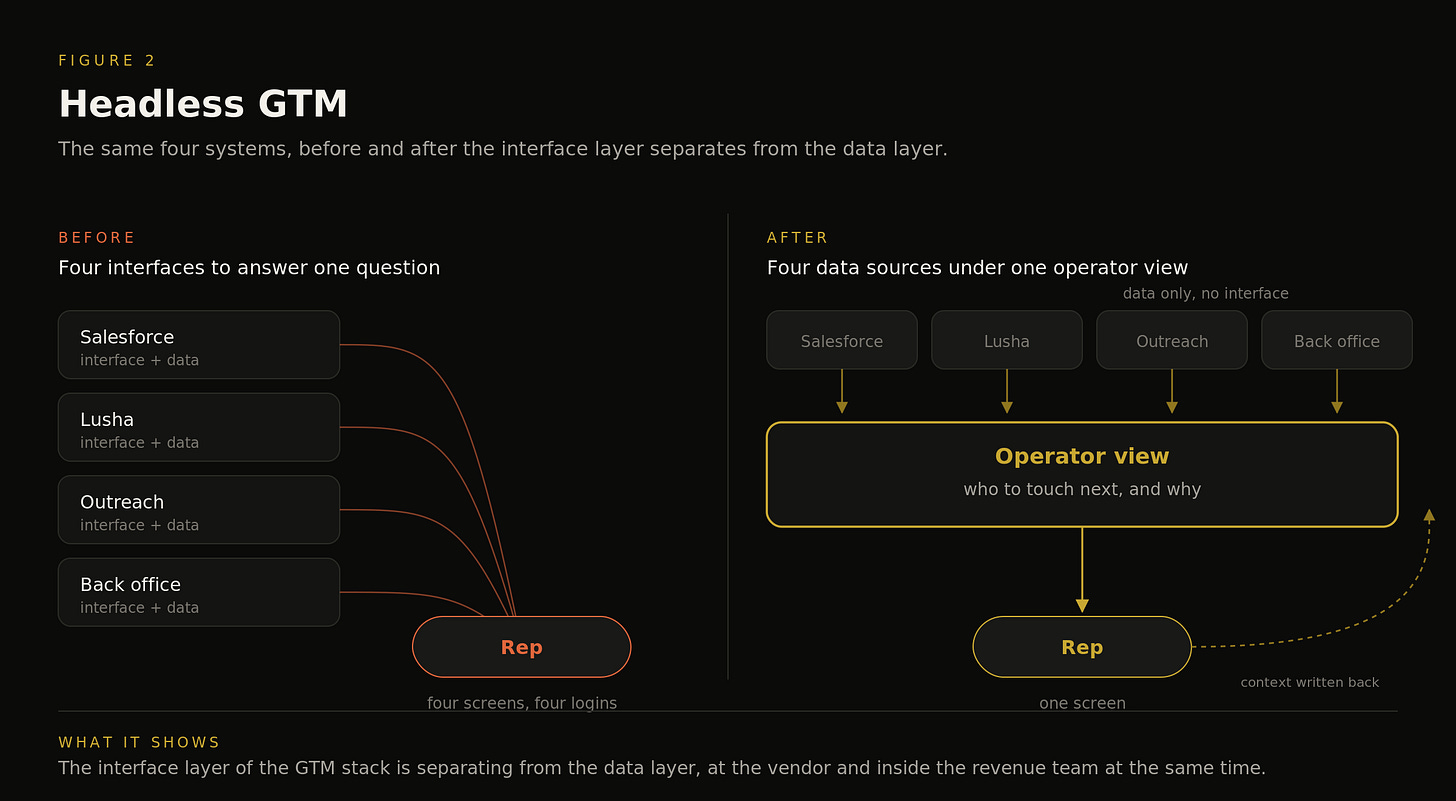
Figure 2. Nothing left the stack. The interfaces did, and the rep’s screen count went from four to one.
Frameworks from the episode
- The Two-Layer Retrofit. Yoni’s structure for moving an existing company into the AI era. Layer one is the product: make it AI-ready, API and MCP based, consumable by agents, or the market routes around you. Layer two is the operation: run the company itself on AI, or you carry too many humans to stay efficient. Both layers are iterative and neither is ever done. The output is a company whose product can be bought by machines and whose org can be run lean enough to keep shipping it.
- Builders for Builders. The internal mechanism that makes layer two real: a dedicated team that builds skills and automations other teams adopt, paired with all-hands sessions where divisions demo their AI initiatives to each other. The output is horizontal adoption without a mandate, because every team is borrowing working examples instead of reading policy.
- Headless GTM. The end state Lusha’s own stack is reaching: the CRM and the tools stay, but as data sources underneath a custom operator view that aggregates them into one prioritized surface, with context inserted back automatically. The output is reps who work one screen, and an org whose interface layer is designed around its own motion instead of its vendors’ products.
What to do this week
- Measure your data decay against your sequence length. Pull the last list your team worked and check what share had decayed by the final touch. That number decides whether your data layer is agent-ready or a liability you are about to automate on top of.
- Ask every data vendor for their machine interface. If the answer is an export button rather than an API or an MCP, you are buying static lists in a market whose static list is, on Yoni’s timeline, three years from irrelevant.
- Count the interfaces your reps cross to answer “who do I call next.” If it is more than three, pilot one aggregated view for the top workflow and watch whether your reps stop opening the CRM voluntarily.
- Run one ranked brainstorm. Yoni’s growth mechanism is a session where ideas arrive without pre-approval, get ranked by cost and impact, and the top few get run without knowing whether they will work. One session, this week, with the explicit rule that trying and failing is acceptable.
Why this matters
Every GTM team is wiring agents into a stack whose bottom layer was built for a different buyer. The lists, the forms, the interfaces, and the refresh cadences all assume a human is in the loop to notice what is wrong, and the agents being deployed on top of them assume nothing at all.
The uncomfortable part of Yoni’s argument is that it prices the mistake. Bad data used to cost a wasted dial. Through an agent it costs compounding, undetected error at execution speed, which is why the quality of what your automation consumes is becoming the ceiling on how much automation you can afford.
The vendor-side lesson generalizes inward. Lusha is deleting the half of its product that stopped mattering while the business still runs on it, and most revenue teams have not run that exercise on their own stack: which historic strength is now dead weight, and which quiet layer is now the whole game.
The orgs that act on this will audit the data layer before they scale the agent layer, and buy on machine interfaces rather than dashboards. The ones that wait will find out about decay the way agents find out about everything: not at all, until the pipeline shows it. This is GTM Vault.
Send this one to whoever owns your data vendors and whoever is building your first agent, because they are about to be the same problem.
Connect
Follow Yoni Tserruya // Lusha
Follow Rick Koleta // GTM Vault
Thanks for listening. See you in the next episode.
P.S. Annual paid subscribers get a Private GTM Blueprint Session.
Full transcript
Machine-generated transcript from the episode video. Speaker labels are not included and some names and product terms may be transcribed phonetically.
[0:00] In 3 years, the static lead list is irrelevant. All the simplicity of user interfaces, very sleek UI, that's irrelevant today. Agents in production for go to markets are real. And we're starting to see SDR agents, BDR agents doing better work at certain areas better than humans. We're pretty close to the point that B2B companies will put it instead of SMB reps. Early adopters are starting to build agents and put them in production and trust them. But still what we are seeing is that quality matters, accuracy matters and if you get coverage and hit rate but the data is inaccurate then you are paying higher price eventually. The level of trust is is becoming higher and higher month over month. So for us, how do we provide a product that is only API and MCP based and integrated everywhere but provide very good data and make them choose our platform product. The machine needs trusted data. Machine will never know to identify that the data is wrong. When a
[1:03] human being was behind the engagement then if it was wrong the human knew it was wrong and can flag or this data is not good enough. When you put an agent and the agent rely on bad data, the damage or the level of how wrong the process becomes can be much bigger and it's going to take you longer time to identify that. So if customers just want large lists of data without relevancy and just you know bombard everyone then it's easy to create garbage. But customers that are really doing successful outboard are the ones who Welcome to GTM Vault. The list was exported. The sequence was loaded. The reps worked it for 3 weeks.
[1:56] By the time the last contact was touched, a third of the data was already wrong. That decay rate was tolerable when humans work lists over weeks. It is fatal when agents work signals in seconds. In this episode of GTM Vault, Yonyi Seruya explains why Lucia stopped selling static lists to humans and started building the data layer that AI agents query live. My guest today runs the layer this show keeps circling back to the data agents have to trust at the moment they act. Yoni Seruya, co-founder and CEO of Lusha. 10 years in, Lusia has gone from a contact lookup extension to the data layer AI agents query live verified provider and Clay's ecosystem waterfalls with scale stack, a decision makers API built for machines, not people. Today's question, when agents do the selling and eventually the buying, who owns the data they trust? Yonyi, thanks so much for joining us. Thanks for inviting me, Rick. Happy to be here.
[2:59] Now, I want to start off with walk me through the moment you re realize the buyer of your data was about to stop being a person. Well, I think uh you know all of us started to understand how big this transformation is of the AI and for us is just it's hitting us months over months and quarter after quarter. I think that the moments we understand that the buyer is going to be agents or at least this revolution is really coming to the GTM in real is not just you know science fiction is actually happened a few months ago when we realized that agents in production for go to markets are real and we're starting to see SDR agents BDR agents are running and doing better work at certain areas better than humans and we're willing to put them in production and also customers are willing to put them into production when we understand that if that's the case then agents are going to be you know the future the real future persona of our data and the context that we are was there one customer or usage pattern that forced it
[4:02] or it was more so that you realized this inflection point was coming and you wanted to act before the market ahead of the curve. I think I think we started to notice that the real advanced customer are starting to do so. The majority of customers are still not there but I think that the early adopters are starting to build agents and put them in production and trust them. We also started to do it recently and we we you know the level of trust is is is becoming higher and higher month over month. So I still think it's not we're not yet in the inflection point that all the market is already there. But the fact that enough early adopters are starting to do so and they see real results in production means that it's getting there. It's getting traction and we will probably see it in the next one or two years. You call this the biggest product evolution in Lushia's history.
[4:55] Strip the launch language. What actually changed and what did he have to break to ship it? Well, I think I think the reason we we succeeded at the beginning and the reason we are here was that we always were able to provide very good quality and high quality of data, coverage of data, let's say very good data. And the second part was always simple user experience, simple, you know, flows. Every user can just log in, start using it, self-service, starting for free and just buy self- service by themselves. And I think the data part stays and it's still relevant in the AI revolution. But all the simplicity of user interfaces, very sleek UI, basically that's irrelevant today. So for us we should reinvent ourselves in okay how do we provide a product that is only API and MCP based and integrated everywhere and not necess and customers are not necessarily going to use our interface anymore but we still need to provide very good data and and and make
[5:58] them choose our platform product and that's that's different thinking and and for us it required a lot of changes on on how we think about the business and and we're still we're still in that process but I think It's already started. Yeah, for sure. Define the waterfall from the vendor side. Six providers stacked, first verified, hit wins. What does that do to everyone's economics? Um, yeah, I think I think first of all, I think waterfall are uh something very natural that happened in the industry because in the past you typically bought three vendors and you as a customer need to take care of everything. I think waterfall provides you simpler one-stop shop solution that you can get higher coverage with just one provider or at least one orchestrator. So I think it's becoming natural but still what we are seeing is that quality matters, accuracy matters and if you get coverage and hit rate but the data is inaccurate then you are paying higher price eventually. I think I say it even even it's even bigger than that because when a human
[7:00] being was behind the engagement then if it was wrong the human knew it was wrong and you know it can flag or this data is not good enough. When you put an agent and the agent rely on bad data the the the the damage or or you know or the level of how wrong the the process becomes can be much bigger and it's going to take it might take you longer time to identify that. So actually what we see that actually still matters still hard to provide that and we are providing a very good and very high quality of data globally today both in the US and in Europe. So I think that still matters and and customers who need quality compliant data still choose the right vendors even if it's a waterfall mechan clay is the layer that commoditizes vendors like you. Why join it? Well, first of all, I think I think Clay did amazing work in orchestrating and becoming the orchestration layer for go to market and revops and sales ops and those roles. For us, we're not trying to be the orchestrator. We're just trying
[8:03] to be the best context layers, best quality of data that feeds every rep, every agent, and every workflow. And as long as they are a major orchestrator, we want to be there as exactly as we want to be in cloud and every other orchestrator like NA10, make.com, Zapier, you name it. So for us like for us the interface of how you want to consume the data is agnostic. We just want to be everywhere and clay is one of the strongest player for sure. But I must say that the way we see the market, we see now more and more platforms are that are building waterfalls and and it's just going to be like everyone going to have waterfall eventually. So because we are agnostic to the platform, we just want to be integrated to everywhere we can and everywhere the customers live in. Scale stack runs waterfall logic across 60 plus sources.
[8:54] Where does LSA win inside someone else's waterfall and where do you lose? Well, I think uh in quality and coverage we typically win a very good quality of data and I think that customers that needs high quality to rely on they they typically choose Luchia also compliant and like trusted data. I think that we might lose in price. We're not the cheapest but it's you know it's come with the quality. We we we work very hard to improve the accuracy and to provide that output, but we are still pretty affordable and you know starting from $49 a month. It's really something that any company can afford for quality of data. Agent to agent selling mechanically, a vendor agent and a buyer agent meet.
[9:36] What happens step by step? I think you know I think it's a good question. I didn't see it in action yet, but I can imagine that when a human to human talks to each other, there there are a lot of discovery questions during the call that you need to ask to identify to understand like the match or like is it is it a good lead and does this provider is a good provider for you. I think when an agent and agent talk because they have access to all the data in the world and and you know quality of data they can read all the reviews they come very very very informed and educated then I think the discussion will you know we'll skip a lot of the discovery questions and we'll go straight to more technical pricing integrations and specific needs that might not be available publicly the decision makers API is built for a machine caller. What does an agent need from a data vendor that a human never did?
[10:37] I think I think the machine needs you know trusted data. Machine will never know to identify that the data is wrong. It's going to be harder for the for the machine to do so. And also I think the way we think about it today agents can take data and they need to work very hard. I think eventually what agent will want will want that the data provider will learn the agent needs and provide the relevant data that the agent needs so that it will skip a lot of the processes and verifications and tokens that today the agents needs. It's going to make the agent way cheaper when the AI that feeds them knows which leads to provide you know prioritize and without any cleanup processes there. Full sales autonomy is your north star. Where is the industry at today? And what is the rate limiter models data or would you say the buyer?
[11:29] Well, I think I think you know really create autonomous sales rep. There's still there's you need to educate the the this rep a lot about your your product about your you know how does it works? How exactly does it fits for every industry? It's not it's not just about generic sales intelligence. you really need to train about how to sell your product. I I I still didn't see it in action in a good good enough that customers are putting it in production at least not in B2B. I see it in B2C but I think we're pretty close to the point that you know B2B customer B2B companies will put it instead of SMB reps and afterwards they might also put it even in mid-market deals. I don't think in enterprise deals it will ever be there because enterprise requires way more relationship and sophistication but I can see the transactional sales getting there pretty soon. The technology basically is there just a matter of you know when it's going to be ready.
[12:25] Yeah. And wouldn't you say low-end SAS is similar to B B T B T B T B T B T B T B T B T B T B T B TOC Anyways. So yeah, I could I could see that probably need a human to be driving most of that interaction even a year or two from now. So when both sides run agents, volume is free and trust is scarce. What keeps agent to agent from becoming spam to spam? Well, I think spam is it's a big problem already even before AI and I think with AI it can be you know huge amount of spam in the world. But I you see also the other side. You see better spam detectors. You see now when you're calling to iOS device, you cannot you're not necessarily going to get the the call you need to text. Why are you calling? So eventually I think the reason you call, like why you call, if it's really a relevant call, then that's going to be the real key for success because I think that's the reason for where people that's the reason why people will really want to talk to you.
[13:24] And also that's the reason why spam detection won't filter you out. You said you said spam detection won't filter you out, right? Yeah. I mean, if if you have a good reason that you're calling me, then I going to see that text message in my device and I going to answer you and I think without that probably you might be filtered. So those kind of things going to be harder in the future. Totally. Yeah, I see that. Where has an agent with full access to your data still produce garbage? You know, I think I think if if if customers just want large lists of data without relevancy and just, you know, bombard everyone, then it's easy to create garbage. I think customers that are really doing successful outboard are the ones who really pick the most laser focused target audience for them and not necessarily trying to take large list without relevancy. That's I think what we see. want to talk a little bit about building AI first and the new org. You are retrofitting AI first onto a 10-year-old company. What did you
[14:28] dismantle teams roadmap metrics? First of all, I think you know taking an existing company and make it like adopting AI is is very challenging and a very iterative process. So it's not something that just happens. It's not just something that you say. It's it's process in two layers. First of all, you need to take your product, whatever you have in your product and make it a ready product because if you won't then you're just probably going to be behind the competition and going to be lack of capabilities and that's a big challenge by itself becoming an AI ready product. The second part is that let's say you have an AI ready product, you also need that operationally your organization will be powered by AI. Otherwise, you're just going to you're going to have too many human beings in your company and and you're just going to be efficient.
[15:18] So, it's basically you have two layers improving the product and improving operational you constantly needs to evolve and it's an iterative process. So for us it contains tons of initiatives starting you know starting with enabling everyone any AI tool they need letting everyone get access for that creating sessions where people just share with all the company like you can you have like once every every once and two we just make an all ad when we're just sharing all the AI initiatives we've done across divisions so that you can see and you get ideas from other departments trying to share and and build we created a team we call it builders for builders. This is a team that builds skills so that other people in the company will use those skills and and work better. It's just, you know, it's just everywhere. Uh we're just doing it everywhere. And also part of the part of the thing is if you have a team that did not adopt AI and it's hard for them to adopt sometimes what you need to do is create constraints and and and reduce the amount of people in the
[16:20] team, but the amount of work is not changing. So they have to adopt AI right now and and it's kind of an iterative process that you constantly reduce them to to to enforce that adopting AI will be necessary. I'm just sharing uh I'm just sharing a lot of initiatives like that but it's it's constant and and it's actually it's actually never ending and we're still there. It's like you are always trying to put AI whenever you think it's possible to to do the work with AI. I love that. I love that. I mean, especially considering there's no playbook for this, right? It's so experimental. We're just learning as we go, right? Exactly. And and it's there is no playbook and you cannot hire an expert that will make it happen because it's just happening now and it's happening so fast. If you think about it like eight months ago, Claude, nobody talked about it like you know Clude eating the world in eight months. Like everything everything happens right now.
[17:20] It's written. The history is written. So, so you need people you basically what you need to do is create a culture of curiosity, culture of people who are constantly learning and and also create a culture that people won't be afraid to try and fail. That's okay that they will try and it didn't work but we want to try a lot of stuff. So, it's building mentality. It's it's it's moving fast and learning mentality. And if you do that enough in enough areas, then the results I I love that. Yeah. Uh how like building a culture where people are okay with failing. The thing is I want to say one thing that's not talked about that much. It's so hard to do that as a CEO, especially when you're in a position where you want to tell people what to do and kind of micromanage them to get immediate results. It becomes so challenging having having been a CEO nearly a decade ago of influencer marketing platform. I want to say that was one of my biggest challenges back
[18:22] then is just kind kind of letting people free reign opposed to or at least giving them pockets of time to be more experimental opposed to like always just executing their tasks. How do you balance that? Well, you think you know we're doing a lot of brainstorm sessions to think how how can we change the trends of stuff. So you know for example we can do a brainstorm session of how do we create growth and the idea is to bring ideas. So and then we rank those ideas by you know the the cost and and impact and we choose few but you know the mindset of the discussion is come and bring ideas and then we don't know if it will work but we know we're going to do it and then people started doing it. So, and if you are doing it enough, then people understand that you are willing to try stuff. You don't know if they will win, but you just want good ideas to be on the table at every given moment. And I think that's creates I think the essence of of of everything we just said.
[19:18] That's great. It speaks to your leadership style. It sounds like uh you're not thinking like I have the best idea all the time, but rather, you know, anyone can come up with a good idea and as long as you can create an environment where people feel confident enough uh comfortable enough to share those ideas, it can come from any anyone, right? Any department really. So, inside Lucia's own GTM, something I'm curious about is what does a GTM engineer own that RevOps does not? which role absorbs the other. Basically for revops we don't have anyone who we just call GTM engineer. For us it's revops it's pretty similar for us but typically revops are owning all the all the middle of the funnel pipeline generation sales rep visibilities lead calling lead qualification everything that's everything that supports the sales organization everything that supports the the lead flow and pipeline generation. We do have more people in the marketing department that are
[20:20] generating demand. I just think for I think I think the names are um you know every company can use the name for for anything you just mentioned right for us yeah call it revops but it's I think it's we we are mentioning the same thing and how does Lucia run Lucia what is your own stack and where is your data layer in it first of all we use Lucia like for everything like every lead scoring lead enrichment lead prioritization reach outbounds risk assessments of existing customers for everything. We just use our data, website visits, reveals, stuff like that. I can say that our stack is um is really evolving now. Well, I think you know we have the typical stack you know like everyone else but what we see is that we're starting to be real headless and we're starting to build to aggregate data from multiple sources and build our own dashboard that are really custom made for our pro process. So like few months ago our aid is still open Salesforce for everything they've done and I think in
[21:24] the last months they they reduced like they they they almost don't open Salesforce anymore. They have a custom view that we've built. We took data from Salesforce, data from Lucia, data from our outreach, data from back office, data from multiple sources and just provide them a a a custommade dashboard that they know exactly who to target and who to reach out and it's create their life much simpler and much easier. So I really see it's changing very fast now and I believe go to market will become headless in more and more companies because it just creates a much simpler operation. So your sales reps interface with your custom dashboard on a day-to-day basis then and uh when they put in an input does that get synced everywhere else is do you get like a slack message to other so how is that context then shared across the organization or even that department most of the context is uh is is inserted automatically to the platform like if you did engagement we see the engagement
[22:27] automatically if it was you email or phone if you did Zoom call and you we have the transcript then the transcript is you know summarized and inserted to the CRM automatically we're we're reducing everything we can from their manual work so what they really need to know is to have clear visibility of on on their opportunities and lead and know where to reach out to and that's becomes mainly the dashboard and the how effective the dashboard provide them all the data they need okay I want to talk a little bit about the competitive landscape and pressure test what you guys are doing. You know, operators are killing six figure zoom info contracts with clay native stacks. Make the honest case why does the same operator not kill Lucian?
[23:11] Next, Luchia is not a six-f figureure test deal. Luchia is a usagebased pay as you go bottom up PLG platform. We are providing the best accuracy and coverage in the market and we do also have waterfall right now. So basically if you need a one-stop shop provider with a decent price that is searchable that learns your needs and provide you personalized results are actually the only way the only the only platform in the market that provide you the quality of data with this amount of this price level. Apollo bundles engagement clay aggregates everyone. Zoom info owns enterprise. What position does Lucia hold that survives all three? We are the context layer that's going to feed every agent in the market. We have the best data and not just for enterprises for every company for any SMB and midm market. So if you need the context layer data you can build on Lucia is probably the best solution out there that integrates with any platform that you use anywhere you need it. Browsing
[24:13] agents can already find and verify contacts on the open web. What stops the layer above from absorbing you? LLM can search what exist on the web but you don't have accurate connect details on the web and you basically don't have a database on the web. So for example if you need all the companies just you know the traffic is just rising and they hired a CRO recently and LLM doesn't have this data because LM doesn't have database that is designed for go to market and that it's searchable. It can give you five five results 10 results. it cannot give you like 5,000 results sorted and and something you can trust. So LLM does need trusted database to rely on like Lucha and this is exactly what we do and by the way we do have cloud extension and open AI chpt extension and cloud choose Lucha over and over again because a cloud doesn't have the data itself. So we're we're completely completing the LLMs with the data that we are building and and work.
[25:14] I didn't know that. That's that's awesome. So that makes things so much more accessible to say a small business sales team that is working within cloud. Now all they need is a Lucia subscription and they can just connect it and keep working within cloud. Yeah, you get all the data access, you build your workflow, you beat your agent, the agent can send emails, you can do everything in cloud. Cloud is basically the new orchestrator if you think about it of the go to market. So yeah, if you have you can do anything. And one thing I want to ask about compliance, is it a moat or attacks? Where does it win deals and where does it lose them? I think it's both most mo and attacks. I think not a lot of companies know how to, you know, provide data in a compliant way. They're definitely not a lot and it's definitely something that we pay a lot to to play the game. So I think I think it's more of a mode because eventually there are very few amount of companies that are, you know, able to do so.
[26:11] Want to talk a little bit about the next two years. Paint 2028 a revenue team of what size running what agents and what does the human do all day? I think that uh today you know sales reps are actually interacting with customers let's say third of their day even 20% of their day like real engagement real zoom calls you're providing value all the rest of their time is a lot of manual work a lot of reach out tries a lot of emails and I think two years ahead I think agents and AI will take all the admin work of your plates will do everything for you all the research all the ad all the admin stuff, all the email sequencing, everything for you and the agent will basically maximize the amount of time that sales rep are engaging with customers and providing them real value over a zoom call. So if today is 20%, 30%, I think in two years it will be 50 60% and you know even more I don't know it's depending on efficiency but each rep will do more
[27:14] their quarter will be higher they will sell more but they will do less manual work. So basically AI will do what AI do best and humans will do what human do best which is building trust with other humans and actually solve problems. Absolutely. I see that I see that gear going mainstream in the next 18 months for sure and not to mention next yeah. All right. Now I want to move on to the rapid fire section of the pod. One GTM metric that deserves more attention this year. I think API adoption. Most overrated capability in revenue AI. I think uh transcripts and call recordings. One data source most teams pay for and should not.
[27:55] Wow, that's hard one. I think company data will become commoditized. A habit or mental model that shapes how you build. Just, you know, start small, iterate fast. That's a habit. Complete the sentence. In 3 years, the static lead list is irrelevant. Yonyi, thank you. 10 years of contact data rebuilt as the layer agents call. This show established that agents are only as good as the context they reason over. This episode named the layer underneath the context data that has to be true at the moment the agent acts. If this episode sharp into your GTM lens, subscribe, share it with your team, and come back next week. This is GTM Vault. Build systems, not noise. All right.